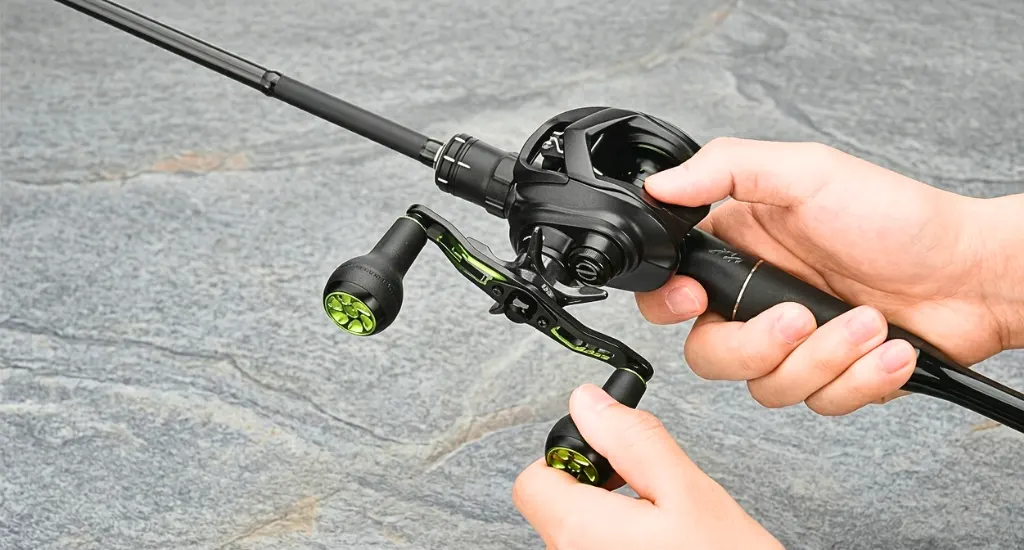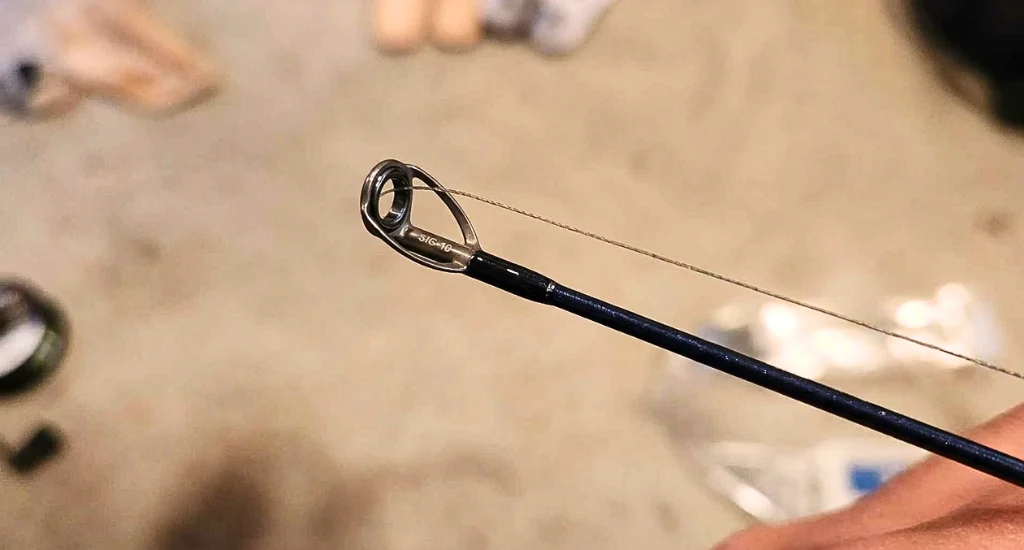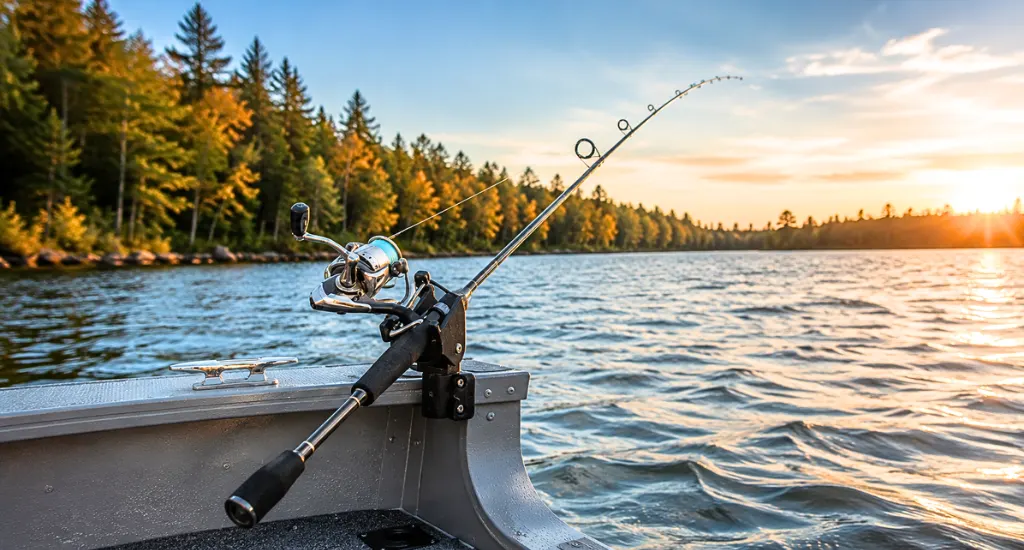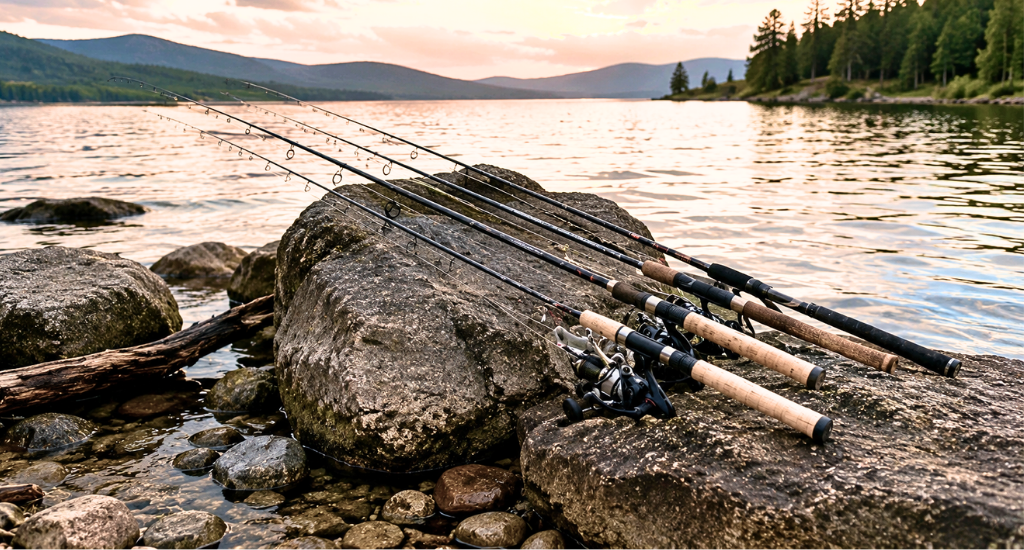
A medium fishing rod handles lures weighing 1/8 to 5/8 oz and 6- to 12-lb line, ideal for finesse techniques and open water. A medium-heavy fishing rod handles lures weighing 3/8 to 1 oz and 10- to 20-lb line, ideal for heavy cover and bigger fish. The right choice comes down to lure weight, line weight, and where you fish.
The decision matters more than most anglers realize. The wrong power class costs you sensitivity on light bites, casting distance on heavier lures, and hookset strength on bigger fish. After 24 years of guiding anglers across Gulf Coast bays and freshwater lakes, I have watched the same mistake repeat thousands of times. Pick the rod that matches your water, your lures, and your target species, not the rod that sounds tougher on the label.
Here is the fast decision table. Pick your column.
| Buy a Medium Rod If: | Buy a Medium Heavy Rod If: |
|---|---|
| You fish open water with lures under 1/2 oz | You fish heavy cover with lures over 3/8 oz |
| You drop-shot, Ned rig, or wacky rig for bass | You flip, pitch, or punch heavy cover |
| You target bass under 5 lb, walleye, or panfish | You target bass over 5 lb, pike, or musky |
| You use 6 to 12 lb line | You use 10 to 20 lb line |
| You want one rod for finesse and reaction baits | You want one rod for power techniques |
How Do Medium and Medium-Heavy Fishing Rods Compare Side by Side?
Medium and medium-heavy fishing rods differ across 12 specs that shape how the rod casts, fights fish, and matches each technique. The table below covers every spec dimension side by side, so you can match the rod to your water and your lures without guessing.
| Specs | Medium Rod | Medium Rod |
|---|---|---|
| Lure Weight Range | 1/8 to 5/8 oz | 3/8 to 1 oz |
| Line Weight Range | 6 to 12 lb | 10 to 20 lb |
| Best Action Pairing | Fast or extra-fast | Fast or moderate-fast |
| Bend Profile | Bends in the top third with moderate flex | Bends in the top quarter with a stiff backbone |
| Hookset Style | Open-hook, forgiving | Hidden-hook, aggressive |
| Sensitivity | Higher, better for subtle bites | Lower, but enough for most bites |
| Casting Distance (light lures) | Excellent, 40 to 60 yards | Reduced, 25 to 40 yards |
| Best Water | Open water, clear lakes, light cover | Heavy weeds, timber, lily pads, and docks |
| Best Techniques | Drop-shot, Ned rig, wacky, small crankbaits | Texas rig, Carolina rig, spinnerbait, swimbaits, jigs |
| Best Target Species | Bass under 5 lb, walleye, trout, panfish | Bass over 5 lb, pike, musky, large catfish |
| Best Reel Pairing | 2500-3000 spinning, low-profile baitcaster | 3000-4000 spinning, baitcaster with strong drag |
| Typical Price | $50 to $300 | $50 to $300 |
The split is clear when you read the table from top to bottom. A medium rod wins on sensitivity, casting light lures, and finesse techniques. A medium-heavy rod wins on power, cover extraction, and bigger fish. Both rods overlap in the 3/8 to 5/8 oz lure range, which is where most weekend anglers feel torn between the two. Match the rod to your most common lure weight, and you will rarely regret the choice. For a full breakdown of spinning, baitcasting, conventional, and specialty rods, see the types of fishing rods and reels guide.
What Is a Medium Power Fishing Rod and What Is It Used For?
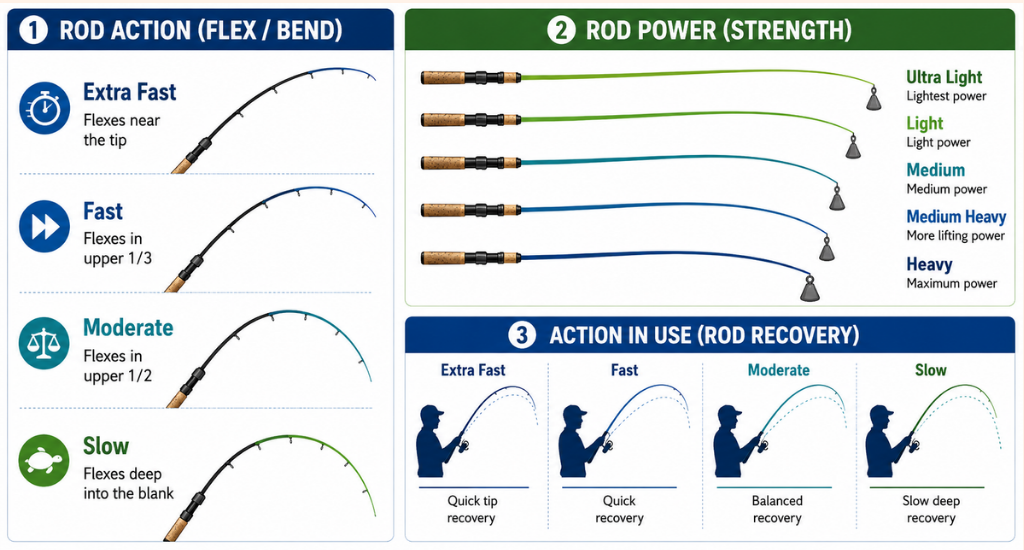
A medium-power fishing rod handles lures from 1/8 to 5/8 oz and line from 6 to 12 lb, with a bend that starts in the top third of the blank under load. The bend gives the rod cushioning during a fight, which protects the light line and keeps small treble hooks from tearing free. Most medium rods pair with a fast or extra-fast action for sharp hooksets on single-hook lures.
The lure range covers the techniques most weekend anglers actually fish. A medium rod throws a 1/4 oz crankbait, a 3/8 oz spinnerbait, a 1/4 oz football jig, and a topwater popper without strain. Medium rods shine on bass under 5 lb, walleye, trout, panfish, and crappie, and they handle drop-shot, Ned rig, wacky rig, shaky head, and light crankbait fishing.
My everyday medium rod is a 7′ St. Croix Mojo Bass paired with a Shimano Stradic 3000 spooled with 10 lb braid. That setup has caught largemouth bass, speckled trout, and walleye across Gulf Coast bays and freshwater lakes I guide. For more on how length affects rod performance, see the What Size Fishing Rod for beginner guide.
What Is a Medium-Heavy Power Fishing Rod, and What Is It Used For?
A medium-heavy power fishing rod handles lures from 3/8 to 1 oz and line from 10 to 20 lb, with a stiff backbone that bends only in the top quarter of the blank. The stiff bend transfers more force to the hookset, drives hooks through bony mouths, and gives you the leverage to pull fish out of heavy cover before they wrap your line.
The lure-and-line range matches power-fishing techniques. A medium-heavy rod throws a 1/2 oz spinnerbait, a 3/4 oz swimbait, a 1/2 oz Texas-rigged worm, a 3/8 oz football jig, and a frog without losing casting accuracy. Pair it with 15-17 lb fluorocarbon or 30-50 lb braid for heavy-cover work.
Medium-heavy rods shine on bass over 5 lb, pike, musky, large catfish, snook in mangroves, and bull redfish. They handle Texas rigs, Carolina rigs, jig fishing, spinnerbaits, big swimbaits, and frog fishing.
My medium-heavy rod for mangrove snook is a 7’2″ Dobyns Champion XP paired with a Lew’s Tournament MP spooled with 30 lb braid. That setup has pulled 32-inch snook out of root systems where a medium rod would have snapped on the first run.
Medium vs. Medium-Heavy Rod: Which One Is Best for Which Fishing?
A medium rod is best for finesse techniques and smaller species, while a medium-heavy rod is best for power techniques and bigger fish in heavy cover. The table below maps every common fishing scenario to the right rod, so you can pick by use case instead of guessing.
| Fishing Scenario | Best Rod | Why |
|---|---|---|
| Drop-shot bass fishing | Medium | Light lure (1/8 to 1/4 oz), light line, finesse presentation |
| Ned rig bass fishing | Medium | Tiny lure under 1/4 oz, needs sensitivity for subtle bites |
| Wacky-rigged Senkos | Medium | Cushion protects light hooks and 8 lb fluorocarbon |
| Shaky head bass fishing | Medium | Open hook set, light line, finesse-focused |
| Small crankbaits under 1/2 oz | Medium | Cushion absorbs head shakes without pulling treble hooks |
| Topwater poppers and walking baits | Medium | Lighter lures cast better, moderate bend prevents hook pulls |
| Texas rig in heavy cover | Medium Heavy | Stiff backbone drives hook through bass mouth, pulls fish from cover |
| Carolina rig bass fishing | Medium Heavy | Heavyweight (1/2 to 1 oz), needs backbone for long-distance hooksets |
| Jig fishing in laydowns | Medium Heavy | Power to extract bass from wood before they wrap up |
| Big spinnerbaits over 1/2 oz | Medium Heavy | Casts heavier lures cleanly, handles larger fish |
| Swimbaits up to 1 oz | Medium Heavy | Backbone supports lure weight, lifts bigger fish |
| Frog fishing in matted grass | Medium Heavy | Hook drive through hollow-body frog plus power to muscle bass out |
| Walleye jigging | Medium | Sensitivity to feel subtle bottom bites |
| Pike and musky with big lures | Medium Heavy | Backbone to handle 1 oz+ lures and toothy predators |
| Trout in lakes and rivers | Medium | Light line, smaller lures, delicate mouths |
| Catfish in moderate current | Medium Heavy | Lifting power for fish in the current |
| Inshore trout and slot redfish | Medium | Light tackle for finesse in bays and flats |
| Snook in mangroves | Medium Heavy | Muscle to pull fish out of the root systems |
| Bull redfish in the current | Medium Heavy | Power for fish over 30 inches in flowing water |
| Ice fishing for walleye | Medium | Sensitivity for subtle ice bites |
| Ice fishing for pike or lake trout | Medium Heavy | Backbone for bigger fish through the hole |
The pattern reads simply when you look at the table. Finesse plus smaller fish equals medium. Power plus bigger fish equals medium-heavy. The 3/8- to 1/2-oz lure overlap range is the only zone where either rod works, and even there, your water type decides for you. Open water tilts medium; heavy cover tilts medium-heavy.
Why Are Rod Power Ratings Not Standardized Across Brands?
Rod power ratings are not standardized across brands because there is no industry body that sets the rules. A medium rod from one manufacturer can feel like a medium-heavy rod from another, which is the single biggest source of confusion for anglers buying online without holding the rod first.
The variance is real and consistent. St. Croix tends to rate honestly, so a St. Croix Mojo Bass medium feels like a true medium. Ugly Stik rates stiff, so an Ugly Stik GX2 medium often feels closer to a medium-heavy in hand. Japanese brands like Shimano and Daiwa tend to rate their products more softly, so a Shimano SLX medium can feel lighter than its label suggests. KastKing falls in the middle but varies by series. The same word printed on the blank means three different things across three brands.
The practical fix is simple. Trust the numbers, not the label. Every quality rod prints the lure and line weight ranges directly on the blank, usually just above the foregrip. Those numbers are what you actually fish with. A rod marked “medium, 1/4 to 5/8 oz, 8 to 14 lb line” is a true medium, regardless of the brand. A rod marked “medium, 3/8 to 3/4 oz, 10 to 17 lb line” is closer to a medium-heavy in real-world performance.
When you can hold the rod in a tackle shop, flex the tip with your thumb, and compare it directly to another brand’s same-power rod. Blank material also plays a role in how stiff a rod feels, which the carbon fiber vs fiberglass fishing rod comparison breaks down in detail.
Medium vs. Medium-Heavy Rod for Inshore Saltwater Fishing: Which One Wins?
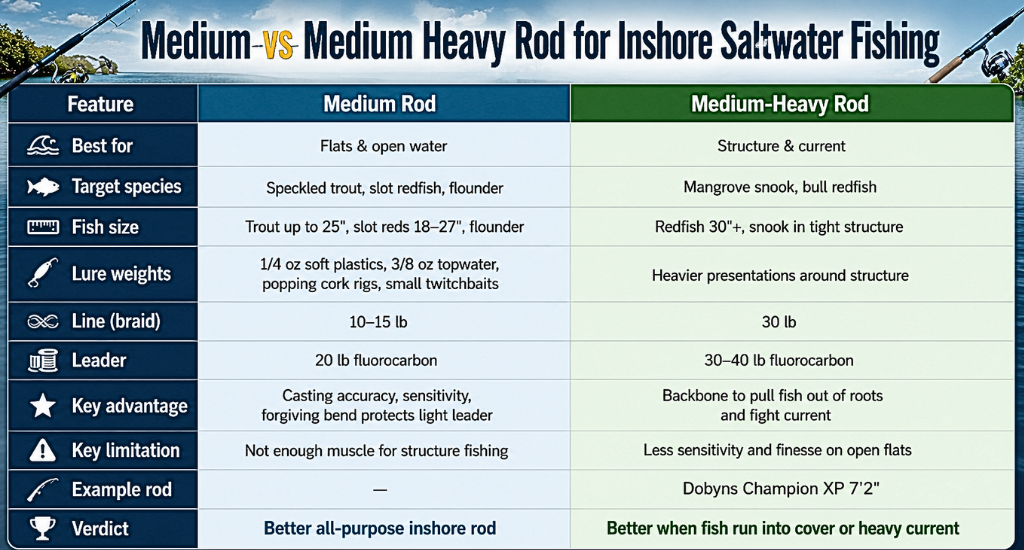
A medium rod is the better all-purpose inshore rod for speckled trout, slot redfish, and flounder, while a medium-heavy rod steps up for snook in mangroves and bull redfish in current. The Gulf Coast bays I guide cover both scenarios in a single trip, which is why most serious inshore anglers carry one of each. For length recommendations across inshore species, see the best size rod for inshore fishing guide.
A medium rod wins on the flats and in open water. It throws 1/4 oz soft plastics on jigheads, 3/8 oz topwater plugs, popping cork rigs with live shrimp, and small twitchbaits with the casting accuracy and sensitivity these techniques demand. Paired with 10 to 15 lb braid and a 20 lb fluorocarbon leader, a medium rod handles speckled trout up to 25 inches, slot reds in the 18 to 27 inch range, and flounder without any problem. The forgiving bend protects the light leader during head shakes from bigger fish that surprise you.
A medium-heavy rod wins around structure and in current. Mangrove snook live in root systems that will cut through a 20 lb leader if you cannot pull the fish out fast. A medium-heavy with 30 lb braid and a 30 to 40 lb leader gives you that muscle. Bull redfish over 30 inches in passes and bridge pilings need the same backbone, especially when the current adds 5 to 10 lb of resistance to the fight.
My medium-heavy 7’2″ Dobyns Champion XP has pulled a 32-inch snook out of mangrove roots that a medium rod would have snapped on the first run. The difference is not theoretical. The right rod lands the fish; the wrong rod loses it.
How Do You Choose Between a Medium and Medium-Heavy Rod? A 5-Question Decision Test
The choice between a medium and medium-heavy rod comes down to five questions about your lures, your water, your target species, your techniques, and your line. Answer each one honestly, and the right rod becomes obvious.
1. Do most of your lures weigh between 3/8 and 1 oz?If yes, buy a medium-heavy. The lure weight range is the single biggest factor in rod selection. A rod casts best when the lure weight falls in the middle of its rated range, so heavier lures need a heavier rod.
2. Do you fish in heavy cover like lily pads, timber, mangroves, or laydowns?
If yes, buy a medium-heavy. Heavy cover requires you to pull fish out fast before they wrap your line around the structure. The stiff backbone of a medium-heavy gives you that lifting power, while a medium will bend too deeply to control the fight.
3. Do you target bass over 5 lb, pike, musky, snook, or bull redfish as your primary species?
If yes, buy a medium-heavy. Bigger fish pull harder, take more line, and require stronger hooksets when they have bony or tough mouths. The medium-heavy delivers those hooksets cleanly.
4. Do you use finesse techniques like drop-shot, Ned rig, wacky rig, or shaky head?
If yes, buy a medium. Finesse techniques use lures under 1/4 oz and light line in the 6- to 10-lb range. A medium-heavy is too stiff to detect the subtle bites these techniques produce.
5. Is your line over 12 lb test?
If yes, buy a medium-heavy. Line ratings printed on the rod blank tell you the safe range. Reel size also matters here, which the what size reel for bass fishing guide breaks down. A light line on a heavy rod breaks during hooksets, and a heavy line on a light rod can snap the blank under load.
If you answered yes to three or more questions in 1, 2, 3, or 5, buy a medium-heavy. If you answered yes to question 4 plus low scores on the others, buy a medium. If you split evenly, the rod that matches your most common fishing situation wins.
What Are the Best Medium and Medium-Heavy Fishing Rods by Price Tier?
The best medium and medium-heavy fishing rods fall into three clear price tiers: budget (under $80), mid-range ($100 to $200), and premium (over $250). Spending more buys lighter blanks, better components, and tighter manufacturing tolerances, but a quality mid-tier rod outfishes a poorly chosen premium rod every time. Here are the rods I recommend for each tier across both power classes.
Best Medium Rod Picks by Tier
Budget ($40 to $80): The Ugly Stik GX2 Medium and Penn Pursuit III Medium are under $80 and won’t fall apart in saltwater or freshwater. Both ship as combos for around $70 with a serviceable reel. Expect a heavier blank and less sensitivity than higher tiers, but the durability holds up for weekend fishing.
Mid ($100 to $200): The St. Croix Mojo Bass Medium at $150, the Shimano SLX Medium at $130, and the Lew’s KVD Series Medium at $140 are the workhorses of the medium power class. All three deliver real sensitivity, corrosion-resistant guides, and the kind of fast-action tip that separates a quality rod from a tool.
Premium ($250 to $400+): The G. Loomis E6X Medium at $260 and the St. Croix Legend Tournament Medium at $370 represent the top of the medium power market. Lightweight high-modulus graphite blanks, premium Fuji guides, and tournament-grade construction make these the rods that serious finesse anglers choose for daily use.
Best Medium Heavy Rod Picks by Tier
Budget ($40 to $80): The Ugly Stik GX2 Medium-Heavy and KastKing Perigee II Medium-Heavy handle the under-$80 medium-heavy range. Both use composite blanks with enough backbone for Texas-rigged worms, spinnerbaits, and bass in moderate cover. Components feel basic, but the rods survive years of use.
Mid ($100 to $200): The St. Croix Mojo Bass Medium-Heavy at $150 and the Daiwa Tatula XT Medium-Heavy at $130 cover the mid-tier sweet spot. Both deliver the stiff backbone needed for jig fishing, frog fishing, and Texas rigs in heavy cover, with sensitivity good enough to feel a jig dragging across rock.
Premium ($250 to $400+): The Dobyns Champion XP Medium-Heavy at $280, the Shimano Zodias Medium-Heavy at $300, and the St. Croix Victory Medium-Heavy at $370 represent the top of the medium-heavy market. These rods balance lifting power with surprising sensitivity and survive years of tournament-level abuse.
For a full breakdown of how power and action interact when picking any rod, see the action vs power fishing rods guide.
The Bottom Line
A medium fishing rod handles 1/8 to 5/8 oz lures and 6 to 12 lb line for finesse fishing and smaller species. A medium-heavy fishing rod handles 3/8- to 1-oz lures and 10- to 20-lb line for heavy cover and bigger fish. Pick the rod that matches your most common lure weight and water type.
Before buying any rod, check the lure weight and line weight printed on the blank just above the foregrip. Those numbers matter more than the power label. For more rod selection guides and gear breakdowns, visit All for Fishing.