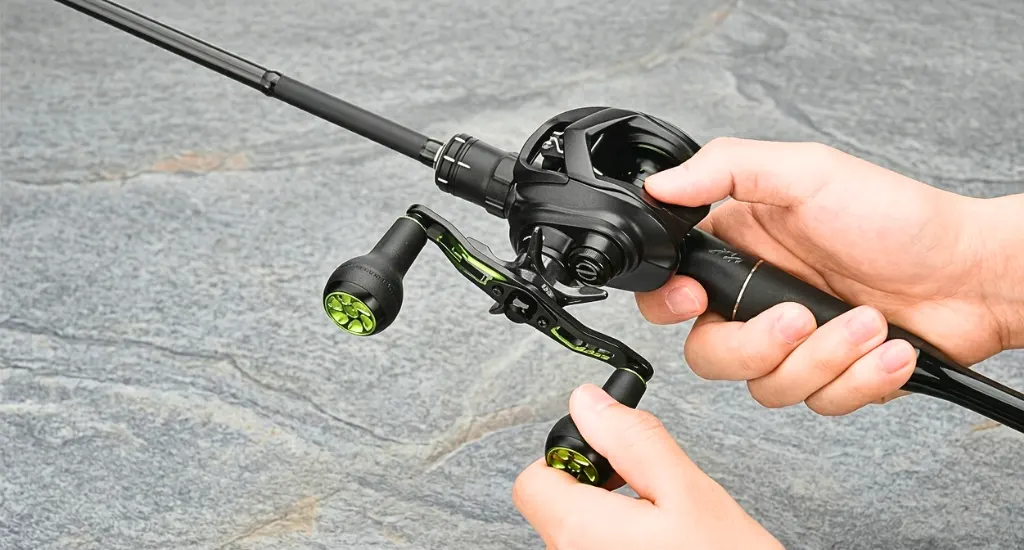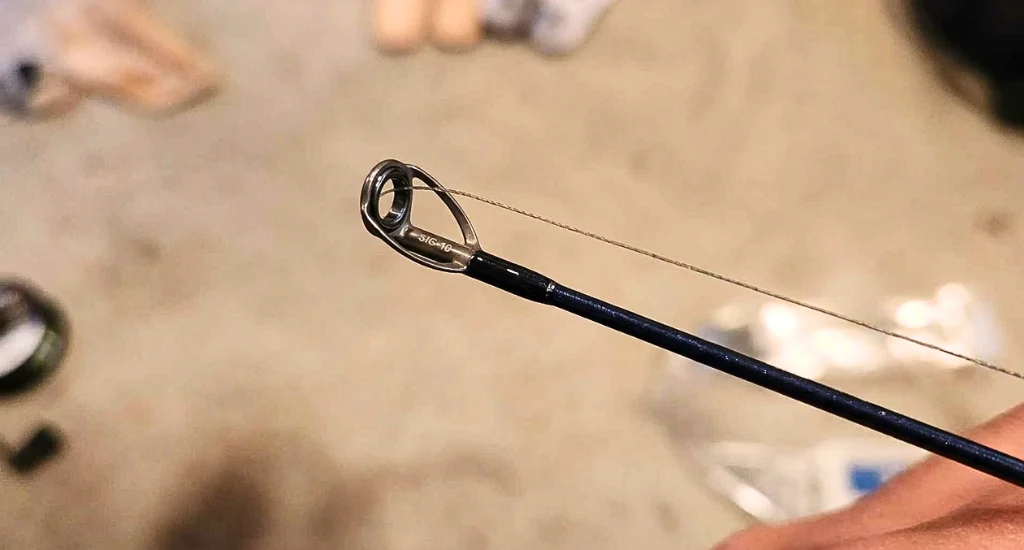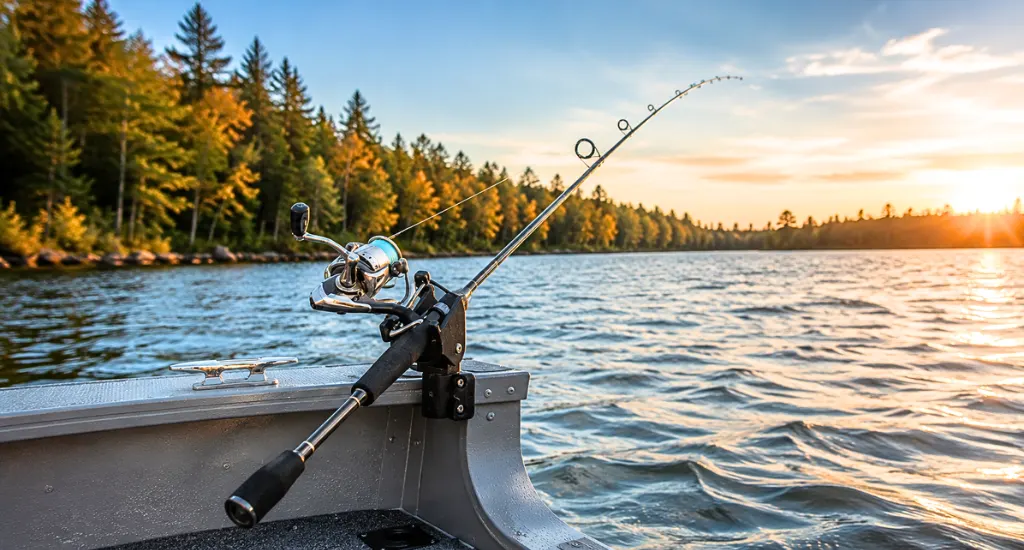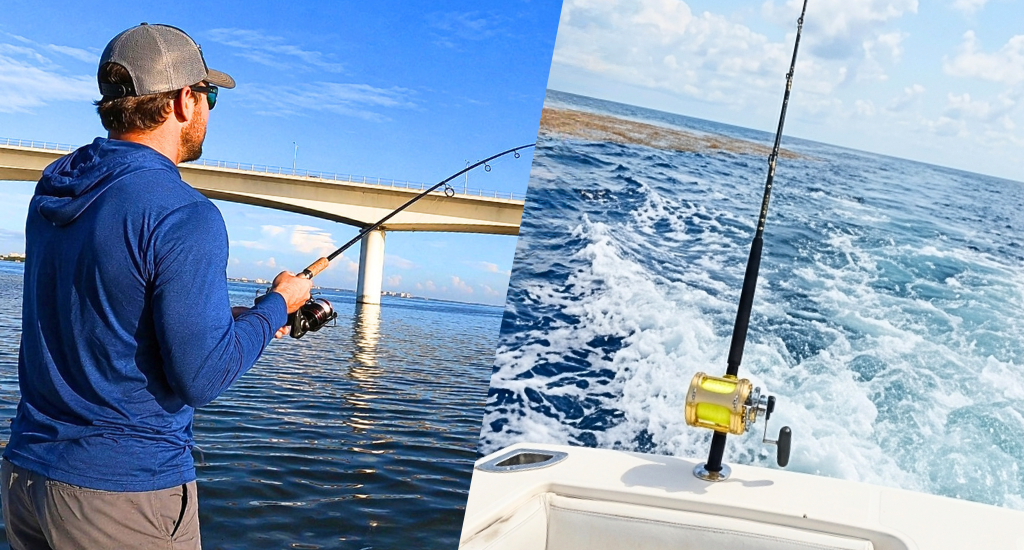
Inshore fishing rods are designed for casting lighter lures in shallow water under 30 meters for species like redfish, trout, and snook. They typically measure 7 to 9 feet with sensitive tips and fast action. Offshore fishing rods are built for deep-sea fishing, usually shorter at 6 to 7 feet, stiffer, and designed to handle heavy tackle and large fish such as tuna, marlin, or mahi-mahi.
The right rod comes down to where you fish, what you target, and how the rod is loaded. Inshore rods favor graphite construction, casting accuracy, and sensitivity for subtle bites in bays, mangroves, and flats. Offshore rods favor fiberglass or composite blanks, lifting power, and components built for big-game fights, like roller guides and gimbal butts for fighting belts.
After 24 years guiding anglers across Gulf Coast bays and offshore runs out of Florida ports, I have rigged thousands of rods for both worlds. In this guide, I break down length, power, action, materials, brands, and price tiers so you can pick the right rod the first time.
Inshore vs Offshore Fishing Rods – Complete Comparison Table
Inshore and offshore rods differ across 15 specs that shape how the rod casts, fights fish, and lasts in saltwater. The table below covers every spec dimension side by side, so you can match the rod to your environment without guessing.
| Spec | Inshore Rod | Offshore Rod |
|---|---|---|
| Typical Length | 7′ to 9′ | 6′ to 7′ |
| Common Power | Light to medium-heavy | Heavy to extra-heavy |
| Common Action | Fast | Moderate to slow |
| Blank Material | Graphite or composite | Fiberglass or composite |
| Line Rating | 6 to 20 lb | 50 to 200 lb |
| Lure Weight | 1/8 to 1 oz | 2 to 16+ oz |
| Guide Type | Single-foot, aluminum oxide | Roller guides, heavy-duty rings |
| Handle | Cork or EVA foam | Reinforced EVA, sometimes aluminum |
| Reel Pairing | 2500-5000 spinning, low-profile baitcasters | 6000+ spinning, conventional, two-speed |
| Target Species | Redfish, snook, trout, flounder, tarpon | Tuna, marlin, mahi mahi, wahoo, sailfish |
| Primary Techniques | Soft plastics, topwater, light jigging | Trolling, vertical jigging, and deep-dropping |
| Casting Priority | Accuracy and sensitivity | Power and leverage, minimal casting |
| Typical Price (Quality) | $100 to $300 | $200 to $700+ |
| Maintenance | Light freshwater rinse after use | Heavy rinse, roller-guide lubing, salt removal |
| Best Brands | St. Croix Mojo, Star Rods Plasma II, Shimano Teramar | Shimano Terez, G-Loomis IMX-PRO, Penn Carnage |
The table makes the split clear. Inshore rods are built around finesse, casting precision, and bite detection in shallow water. Offshore rods are built around backbone, leverage, and survival under sustained drag pressure from fish that can pull a boat. The next sections break down each environment in detail, starting with the inshore environment.
The Length, Power, Action, and Materials of Inshore Fishing Rods
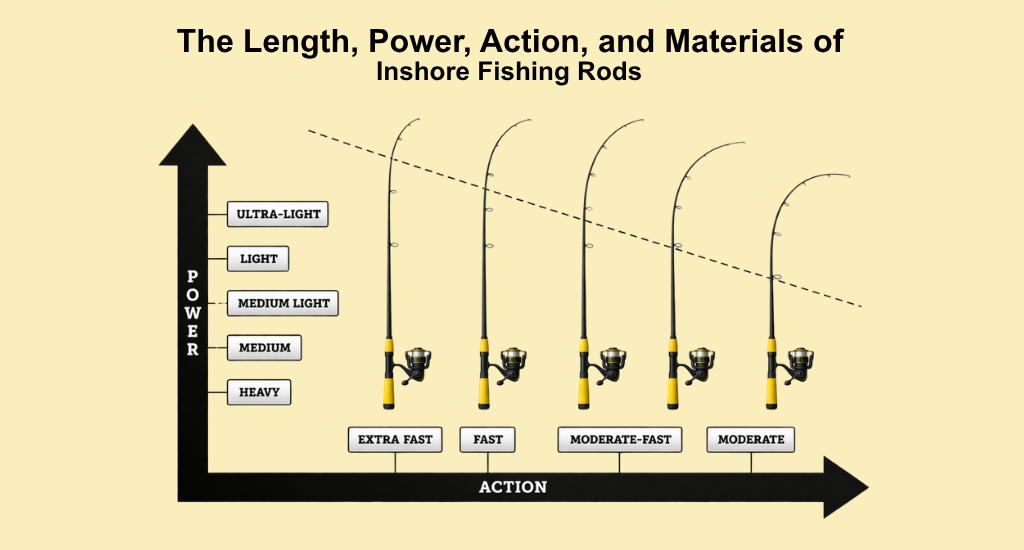
Inshore fishing rods are built for finesse, casting accuracy, and subtle bite detection in water under 30 meters deep. A 7′ medium fast-action graphite rod handles 90% of inshore situations across redfish, snook, speckled trout, and flounder. The specs that matter most are length, power, action, and material, in that order.
Inshore Rod Length and Why 7′ Is the Sweet Spot
The sweet spot for inshore rod length is 7′ to 7’6″. This length casts artificial lures accurately to mangroves, oyster bars, and dock pilings while still giving enough backbone to steer a 30-inch redfish away from structure. Shorter 6’6″ rods work well for tight kayak fishing or pitching live shrimp under docks. Longer 8′ to 9′ rods help when you need to cast farther across open flats, common in sight fishing for tailing redfish or bonefish on the Gulf Coast. For a detailed length breakdown by species, see the best size rod for inshore fishing.
Inshore Rod Power and Action: Medium Plus Fast
Most inshore rods land in the medium to medium-heavy power range with fast action. Medium power handles 8 to 17 lb line and 1/8 to 1/2 oz lures, which covers trout, snook, and slot redfish. Medium-heavy steps up to 12 to 25 lb line and 1/4 to 1 oz lures are the right call for bull redfish, tarpon, and snook around heavy mangrove cover.
Fast action bends in the top third of the blank, giving sharp hook sets on soft plastics and topwater plugs while still telegraphing the lightest tick from a finicky trout. The difference between power and action matters more than most anglers realize, and action vs power fishing rods covers it in depth.
Inshore Rod Materials and Components
Inshore rods are usually built from graphite or graphite-composite blanks because graphite transmits vibration cleanly. The difference shows up the moment a redfish exhales on a soft plastic at the bottom of a fall. Aluminum oxide single-foot guides keep the rod light and resist saltwater corrosion when rinsed after each trip. Cork or EVA foam grips give a tactile feel through long casting sessions and dry fast after rain. The trade-off between graphite and fiberglass shows up clearly when you compare both side by side, which is what carbon fiber vs fiberglass fishing rod walks through.
Best Inshore Target Species and Their Rod Match
Inshore rods are matched to species by power and action. Speckled trout and flounder pair with light-to-medium power and fast action for finesse jigs and live shrimp. Snook in mangroves call for medium-heavy power and fast action with abrasion-resistant guides. Redfish on the flats run on medium power with fast action, while bull reds and tarpon push the rig into medium-heavy with extra backbone. My everyday Gulf Coast rod is a 7′ Star Rods Plasma II medium-fast-action paired with a Shimano Stradic 3000, and it has landed everything from 14-inch trout to a 38-inch redfish without complaint.
The Length, Power, Action, and Materials of Offshore Fishing Rods
Offshore fishing rods are built for raw lifting power, leverage, and surviving sustained drag pressure from big game fish in water deeper than 30 meters. A 6’6″ heavy moderate-action composite rod handles most offshore work for tuna, mahi-mahi, and wahoo. The specs that matter most are length, power, action, and material, with components like roller guides and gimbal butts playing a bigger role than they do inshore.
Offshore Rod Length and Why Shorter Wins
The sweet spot for offshore rod length is 6′ to 7′. Shorter blanks give better leverage during long fights, less fatigue on the arms, and easier control when bracing the rod against a gunwale or fighting belt. A 6′ medium-heavy extra-fast rod handles vertical jigging for amberjack and grouper at 100+ feet without bending into a useless arc. Trolling rods often sit at 6’6″ to 7′ to give just enough length for spreading lines off the boat without sacrificing lifting power. For specific species-by-length guidance on offshore tuna setups, see the best tuna fishing rods.
Offshore Rod Power and Action: Heavy Plus Moderate
Most offshore rods land in the heavy to extra-heavy power range with moderate to slow action. Heavy power handles 50 to 80 lb line and 4 to 8 oz lures or baits, covering yellowfin tuna, mahi-mahi, and wahoo. Extra-heavy power steps up to 80 to 200 lb line for marlin, swordfish, and giant bluefin tuna. Moderate-to-slow action bends deeper into the blank, which absorbs the shock of a 60-lb tuna’s first run without pulling the hook. Fast action exists in some offshore jigging rods, but it remains a minority outside of pitch-baiting setups for billfish.
Offshore Rod Materials, Roller Guides, and Fighting Butts
Offshore rods rely on fiberglass or graphite-fiberglass composite blanks for durability under sustained load. Fiberglass absorbs shock without micro-fracturing, which matters when a 100 lb amberjack tries to dive under the boat for the third time. Roller guides reduce friction on braided line during long fights and prevent line burn at the tip. Gimbap butts at the rod’s base lock into a fighting belt or fighting chair, transferring load from your arms to your hips. Reinforced EVA foam or aluminum grips replace the cork found on inshore rods, since cork breaks down fast under saltwater spray and sustained pressure.
Best Offshore Target Species and Their Rod Match
Offshore rods are matched to species by power and technique. Yellowfin tuna and mahi-mahi pair with heavy power and moderate action for chunking or live-baiting around weed lines. Wahoo trolling calls for medium-heavy to heavy power with fast action to drive hooks home at high boat speed. Marlin and sailfish push the rig into extra-heavy power with slow parabolic action for the long, jumping fights they produce. Grouper and amberjack on the bottom run on heavy power with extra-fast action, since you need to pull them off structure in the first three seconds or lose them. My go-to offshore rod is a 6’6″ Shimano Tallus heavy moderate-action paired with a Penn Squall 30 conventional reel, and it has put plenty of yellowfin tuna in the boat on Gulf trips out of Venice and Port Aransas.
Can You Use an Inshore Rod for Offshore Fishing (or Vice Versa)?
You should not use an inshore rod for offshore fishing or an offshore rod for inshore fishing. Each rod is built for a specific load range, and stepping outside that range causes broken blanks, pulled hooks, and lost fish. The wrong tool turns a good trip into an expensive lesson.
An inshore rod taken offshore fails in two ways. First, the blank cannot handle sustained drag pressure from any pelagic over 25 lb. A 7′ medium-heavy inshore rod rated for 12 to 25 lb line snaps the moment you bow up on a 40 lb yellowfin tuna at full drag. Second, the guides and reel seat are not built for the salt spray, sun exposure, and line tension that offshore fights deliver, so even if the blank survives one fish, the components fail within a few trips.
An offshore rod brought inshore fails in the opposite way. The stiff blank kills casting accuracy on light lures under 1/2 oz, which is most of what works for redfish and trout. A 6’6″ heavy offshore rod with a 50 lb braid setup also overpowers slot redfish and tarpon, ripping hooks free on every head shake. You also spook fish with the loud splash of a heavy lure landing in a foot of water over a grass flat.
I watched a friend rig his 7′ inshore rod for a wahoo trip out of Venice, Louisiana, because he did not want to buy an offshore setup. The first wahoo hit at 14 knots on a 4-oz trolling lure, and his rod snapped clean above the foregrip in the first five seconds of the fight. He paid $180 for a rod he used once. The right offshore rod would have cost the same and lasted a decade. The lesson is simple. Match the rod to the environment, or expect to replace gear and lose fish.
Best Inshore and Offshore Fishing Rods by Price Tier
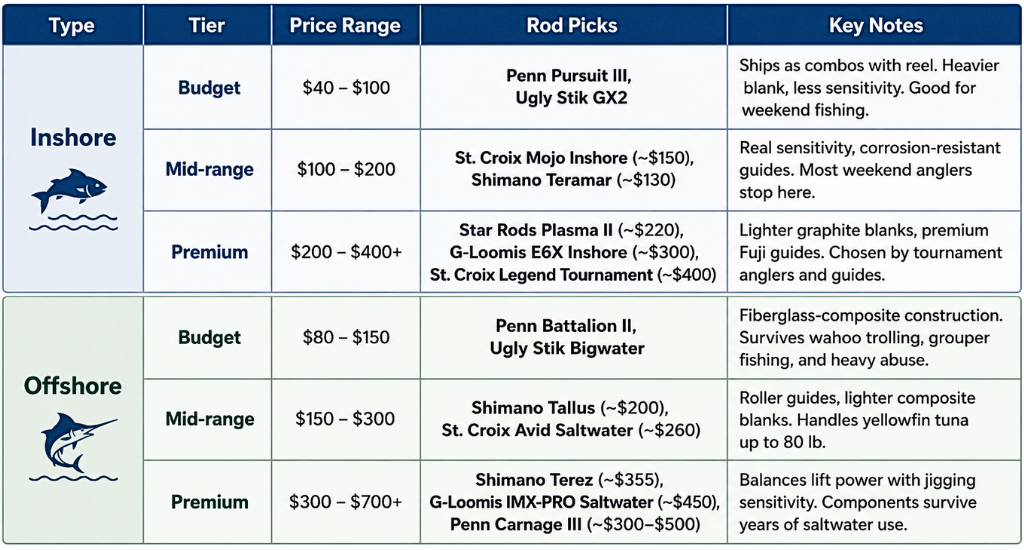
The best inshore and offshore fishing rods sit in three clear price tiers: budget under $100, mid-range $100 to $300, and premium over $300. Spending more buys lighter blanks, better components, and a longer lifespan, but a quality mid-tier rod outfishes a poorly chosen premium rod every time. Here are the rods I recommend for each tier across both environments.
Inshore Rod Picks by Tier
Budget ($40 to $100): The Penn Pursuit III and Ugly Stik GX2 inshore series cover the under-$100 range without falling apart in saltwater. Both ship as combos with a serviceable reel for around $80 to $100, making them the easiest entry point for new anglers. Expect a heavier blank and less sensitivity than higher tiers, but the durability holds up for weekend fishing.
Mid ($100 to $200): The St. Croix Mojo Inshore at $150 and the Shimano Teramar at $130 are the workhorses of the inshore world. Both deliver real sensitivity, corrosion-resistant guides, and the kind of action that separates a quality rod from a tool. Most weekend anglers stop here and never need to upgrade.
Premium ($200 to $400+): The Star Rods Plasma II at $220, the G-Loomis E6X Inshore at $300, and the St. Croix Legend Tournament Inshore at $400 represent the top of the inshore market. Lighter graphite blanks, premium Fuji guides, and aerospace-grade resin construction make these the rods that tournament anglers and guides choose for daily use.
Offshore Rod Picks by Tier
Budget ($80 to $150):
The Penn Battalion II and Ugly Stik Bigwater handle the under-$150 offshore range. Both are heavy and slow by premium standards, but the fiberglass-composite construction survives wahoo trolling, bottom fishing for grouper, and the abuse that ends cheaper rods within a season.
Mid ($150 to $300):
The Shimano Tallus at $200 and the St. Croix Avid Saltwater at $260 give you proper roller guides on the trolling models, lighter composite blanks, and the lifting power needed for yellowfin tuna up to 80 lb. This tier is where most serious offshore anglers spend their money.
Premium ($300 to $700+):
The Shimano Terez at $355, the G-Loomis IMX-PRO Saltwater at $450, and the Penn Carnage III at $300 to $500 cover the premium offshore market. These rods balance lift power with surprising sensitivity for jigging, and the components survive years of sun, salt, and big-fish abuse.
For a deeper breakdown of how to think about rod types beyond price, the types of fishing rods and reels guide covers spinning, baitcasting, conventional, and trolling categories in detail.
Should You Own Both an Inshore and an Offshore Rod?
You should own both an inshore and an offshore rod if you fish both environments. No single rod handles the full range of saltwater scenarios well, and trying to make one rod cover everything costs you fish and broken gear in the long run. The good news is that the minimum two-rod setup costs less than most anglers expect.
The minimum quiver is a 7′ medium fast-action inshore spinning rod and a 6’6″ heavy moderate-action offshore conventional rod. The inshore rod handles redfish, trout, snook, and flounder across bays, flats, and mangroves. The offshore rod handles tuna, mahi-mahi, wahoo, and bottom species like grouper and amberjack. Both rods, paired with quality reels, cover 95% of saltwater fishing along the Gulf Coast, the Florida Keys, the Carolinas, and most of the Atlantic and Pacific coasts.
Budget for the two-rod setup runs $300 to $400 at the entry tier (Penn Pursuit III inshore plus Penn Battalion II offshore with reels) and $600 to $800 at the mid tier (St. Croix Mojo Inshore plus Shimano Tallus offshore with reels). Skip the third and fourth rods until you regularly fish in a specific environment, like kayak or surf fishing. Add specialized rods only after the two core rods get heavy use.
Inshore vs Offshore Fishing: What’s the Difference?
Inshore fishing happens within 9 miles of shore in water less than 30 meters (about 100 feet) deep, across bays, estuaries, flats, and mangroves. Offshore fishing happens beyond 9 miles in water deeper than 30 meters, in the open ocean and deep blue water. The two are different sports that share only the saltwater in which they happen.
The table below covers the 10 factors that separate inshore and offshore fishing as activities, not just the rod choice.
| Factor | Inshore Fishing | Offshore Fishing |
|---|---|---|
| Water Depth | Under 30 meters / 100 feet | Over 30 meters, often hundreds of feet |
| Distance From Shore | Within 9 miles | 9+ miles, often 20 to 60 miles |
| Boat Size | 18 to 25 ft skiffs, bay boats, kayaks | 30 to 60 ft sport fishers and center consoles |
| Trip Length | 4 to 6 hours | 8 to 14 hours |
| Common Species | Redfish, trout, snook, flounder | Tuna, marlin, mahi mahi, wahoo |
| Tackle Weight | Light (6 to 20 lb line) | Heavy (50 to 200 lb line) |
| Bait & Lure Style | Live shrimp, soft plastics, topwater | Trolling lures, live bait, vertical jigs |
| Weather Sensitivity | Lower, protected waters | High sea state matters |
| Skill Floor | Beginner-friendly | Intermediate to advanced |
| Typical Charter Cost | $400 to $700 | $1,200 to $3,500+ |
What Is Inshore Fishing?
Inshore fishing is saltwater fishing done within 9 miles of shore in water less than 30 meters deep. Common techniques include sight fishing on flats, drifting cut bait, fly fishing in shallow estuaries, popping cork rigs for trout, and fishing docks and bridges with live shrimp. Most inshore trips use a 17- to 24-foot bay boat, skiff, or kayak. Trips run 4 to 6 hours; weather rarely cancels them, and the target species- redfish, trout, snook, flounder, and tarpon- stay close to structure.
What Is Offshore Fishing?
Offshore fishing is saltwater fishing done beyond 9 miles from shore in water deeper than 30 meters. Common techniques include trolling spreads for billfish, deep-dropping for swordfish, chunking for tuna, kite fishing for sailfish, and vertical jigging for amberjack and grouper. Most offshore trips use a 30- to 60-foot center console or sportfisher, often with a tower for spotting fish. Trips run 8 to 14 hours, weather can cancel them, and the target species- tuna, marlin, mahi mahi, wahoo, and sailfish- roam open water.
What About Nearshore Fishing?
Nearshore fishing is the bridge between inshore and offshore fishing, occurring roughly 3 to 9 miles from shore in water 30 to 100 feet deep. Common nearshore targets include Spanish mackerel, kingfish, false albacore, and reef species like snapper and small grouper. Nearshore trips use the same boats as inshore fishing but with offshore-style tackle, since the fish run bigger and faster than backwater species.
The Bottom Line
Inshore fishing rods are 7′ to 9′ light to medium-heavy fast-action rods built for casting accuracy and sensitivity in shallow water. Offshore fishing rods are 6′ to 7′ long, extra-heavy, moderate-action rods built for lifting power against big game fish in deep water. Pick the rod that matches the environment you fish in most, and add the second rod when you start fishing both worlds regularly.
Before buying, write down your target species, your typical line weight, and the longest cast you actually need. Those three numbers point straight to the right rod power, action, and length. For more rod selection guides across saltwater and freshwater, visit All for Fishing.
FAQs
What size rod is best for inshore saltwater fishing?
The best size rod for inshore saltwater fishing is a 7' medium or medium-heavy fast-action rod. This length and power combination handles redfish, snook, speckled trout, and flounder across mangroves, flats, and estuaries. The fast action gives sharp hook sets on soft plastics and topwater plugs while still telegraphing subtle bites.
Are offshore rods good for casting?
Offshore rods cast poorly compared to inshore rods. They prioritize lifting power, leverage, and short-fight control over casting distance or accuracy. Most offshore fishing involves trolling, deep-dropping, or vertical jigging instead of casting, so the lost casting ability rarely matters for the techniques for which offshore rods are built.
Do I need roller guides on my offshore rod?
Roller guides are needed only for heavy trolling and big-game fishing with line over 50 lb test. Modern high-quality ring guides with corrosion-resistant inserts handle lighter offshore work for tuna under 80 lb, mahi-mahi, and wahoo without issue. Skip roller guides if you fish with a line under 50 lb.
Can I use a freshwater rod in saltwater?
A freshwater rod can be used briefly in saltwater, but it is not recommended. Saltwater corrodes the reel seat, guides, and any exposed metal within a few trips. Saltwater rods use sealed components, corrosion-resistant aluminum oxide guides, and protective finishes specifically designed for salt spray and humid conditions.
What reel pairs with an inshore vs offshore rod?
Inshore rods pair with 2500 to 5000-size spinning reels or low-profile baitcasters loaded with 10 to 20 lb braid. Offshore rods pair with 6,000-plus spinning reels, conventional reels, or two-speed lever-drag reels loaded with 50 to 200 lb braid. Match the reel size to the line rating printed on the rod blank.