Fly fishing for salmon involves using specialized gear to present flies, often in a downstream swing, to target powerful gamefish in rivers. Key techniques include using sinking lines for deep, cold water or floating lines in warmer, shallower conditions, targeting high-oxygen areas like fast, rocky runs. Successful tactics involve casting diagonally across the current, moving downstream between casts, and keeping flies moving to entice fish.
This guide breaks down salmon fly fishing to what actually works in 2026. You will learn the core presentations, how to read water, and how to time runs, tides, and low-light windows. You will also receive a clear gear blueprint, proven fly choices, and fight-and-release habits that protect these fish. If you can cast, step, mend, and repeat with purpose, you can catch salmon.
What Are the Best Fly Fishing Techniques for Salmon?
The best fly fishing techniques for salmon are the wet-fly swing, stripping streamers, and dead-drift nymphing. These methods work because salmon in freshwater rarely feed like trout. They strike from aggression, curiosity, or instinct when your presentation passes through their strike zone.
This section is the technical foundation. Once you understand salmon behavior, you can focus on speed, depth, and line control, then adapt the same core methods to Atlantic and Pacific salmon in changing conditions.
A. The Wet-Fly Swing: Swinging the Fly While Keeping the Line Tight
The wet fly swing is the gold standard for salmon fishing. It works because salmon hold in lies facing upstream, and a downstream presentation makes the fly travel across their field of vision under steady tension.
Start by positioning yourself so you can cover holding water in a clean sequence. Cast across or quartering downstream at about 45 to 60 degrees. Mend right after the cast to control swing speed, then let the current swing the fly in a smooth arc. Keep the line tight throughout the swing. Slack lines can lead to missed opportunities, unexpected delays, and challenges with hook penetration.
When the swing finishes, hold the fly in the hang-down position for 5 to 10 seconds. Then take 1 to 2 steps downstream and repeat. This step-and-cast rhythm is how you cover water without guessing.
Use line mending to adjust speed. An upstream mend slows the fly, which is better in cold water or when fish are lethargic. A downstream mend accelerates the fly, which can trigger strikes in warm water or when salmon are aggressive. This method shines at walking speeds of 3 to 5 mph, in 4 to 10 feet of water, and along current seams where the fly naturally tracks through the strike zone.
B. Stripping a Streamer: Making the Fly Dart in Pools or Slower Water
The stripping technique is the answer when the current is too slow to swing a fly with purpose. In pools, buckets, and soft edges, you often need to make the fly dart to trigger a chase. This works because salmon still recognize fleeing prey from their ocean life, even when they are not actively feeding.
Cast across or slightly upstream, then let the fly sink. Use a simple count-down method: about one second per foot as a starting point. Begin retrieving with planned variation. Long pulls of 12 to 18 inches imitate a fast baitfish. Short strips of 3 to 6 inches mimic wounded, erratic prey. A reliable rhythm is pause-and-dart: strip twice, pause for 2 to 3 seconds, then hit one hard strip.
Use a two-hand strip whenever you can. Your line-hand pulls while your rod-hand maintains tension and keeps contact. Retrieve slower in cold water and faster in warm water. This approach is especially useful for Chinook in deep pools and for aggressive Coho and Pink salmon in murky water.
C. Nymphing and Dead-Drifting Flies: Presenting Wet Flies or Egg Patterns Naturally
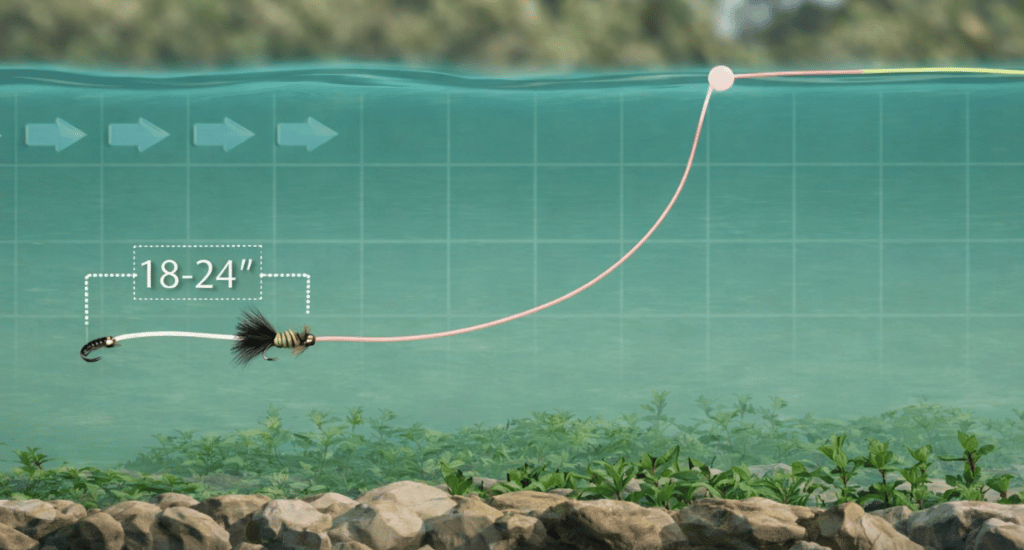
The dead drift technique is the most subtle way to present a fly to salmon. It is also the best choice when fish are pressured, the river is clear and low, or you can see salmon that refuse a swung fly.
Rig with a strike indicator set at 1.5 to 2 times the water depth. Add a split shot 12 to 18 inches above the fly to reach the bottom. Cast upstream or across at about 45 degrees, then high-stick when possible so less line touches the water. Dead drift means no drag. Mend as needed to keep the fly moving at the exact speed of the current.
Strike detection is gentle with salmon. Set the hook on any indicator change: a pause, a twitch, a slight dip, sideways movement, or an unexpected speed-up. Egg patterns work because they resemble loose eggs in spawning areas. Nymphs can work because a drifting object that passes close can trigger a mouth-opening reflex.
D. How to Read Water and Find Salmon (Look for 4- 10 ft. water with Walking-Speed Current)
Finding holding water matters as much as any cast. Salmon rest during migration, so they choose salmon lies that offer depth, oxygen, and a break from heavy flow.
Start with depth and current speed. Look for 4 to 10 feet of water with a current of about walking speed, roughly 3 to 5 mph. Avoid very shallow water where salmon spook easily, and avoid overly fast water where they burn energy.
Focus on specific structures: tailouts, pool heads, deep runs, buckets and depressions, current seams, and the cushion behind boulders. Confluences are also key because they offer temperature relief and a natural pause point. In tidal rivers, salmon often push on the incoming tide and hold during slack or early outgoing water, so fish the two hours before and after the tide change.
E. Key Casting Techniques for Salmon: Spey, Overhead, and Line Control
Spey casting: Spey casting is the most practical way to deliver flies in classic salmon waters because it covers distance without a backcast. Use the Double Spey, Snap T, or Single Spey to reposition quickly. Focus on a clean anchor point, a stable D-loop, and a smooth power stroke. Avoid the Bloody L by widening your sweep, stopping higher, and placing the anchor slightly downstream.
Overhead casting: Overhead casting is suitable for smaller rivers and open banks where you have room behind you. Cast at a downstream angle so the fly starts swinging with purpose, then work methodically down the run. Keep your pattern consistent: cast, swing, step a few feet, repeat. Distance matters less than accuracy and repeatable placement.
Line control: It makes both casts fish well. Use an upstream mend to slow the fly and help it sink. Use a downstream mend to speed the swing and trigger aggressive fish. Add multiple mends during a single swing to maintain the right pace through the current seams. Use a roll cast to tighten slack and reposition the line, especially when lifting sink tips is difficult.
F. What Are the Best Retrieval Techniques When Fighting Salmon?
Once your fly is in the water, retrieval control becomes the whole game. Salmon do not need long to decide. A clean rhythm keeps the fly believable, keeps tension steady, and sets you up to survive the first hard run.
Swinging: Let the current move the fly. Keep steady tension and control swing speed with mends, not strips. Track the line as it arcs through the seam, then hold the fly at the hang-down for 5 to 10 seconds before recasting.
Stripping: Let the fly sink, then vary strip speed to match conditions. Use fast 3- to 6-inch strips in warm water, slower 10- to 18-inch pulls in cold water, and a pause-and-dart rhythm (strip twice, pause 2 to 3 seconds, strip hard) to make the fly “break” like prey.
Dead drift: Do not retrieve at all. Mend often to remove drag and ensure the fly drifts at the exact current speed. High-stick when possible to keep the line off the water, and treat any hesitation or sideways drift as a take, setting immediately.
Hook set: Use a strip-strike instead of lifting the rod. Keep the rod low, then strip 1 to 2 feet with your line hand to drive the hook home. This reduces slack, helps penetration in a tough mouth, and prevents break-offs during head shakes.
Fight control: Maintain a stable stance with your knees slightly bent, and never wrap the line around your hand. Let the drag work, then apply side pressure to turn and tire the fish. Bow to the king on jumps by lowering the rod tip, then pump and reel smoothly, and follow downstream when needed.
What Gear Do You Need for Fly Fishing for Salmon?
The right fly fishing gear makes salmon fishing simpler and safer. Salmon tackle handles long casts, wind, sink tips, and hard runs that can empty your reel. A purpose-built salmon fly fishing setup also protects your tippet and improves hook-ups.
| Gear category | Best baseline spec | Wading notes | Boat notes | Key data to match |
|---|---|---|---|---|
| Single-hand fly rod | 8 to 9 wt, 9 to 10 ft | Better line control at 10 ft in bigger runs | Easy to manage, seated, good for smaller rivers and estuaries | 8 wt for Pink, smaller Coho, grilse Atlantic; 9 wt as all-around |
| Spey rod (two-handed) | 13 to 15 ft, 8 to 10 wt | Best for wide rivers and high banks, no back cast room | Usually not needed from the boat itself | 13 ft 8/9 is a strong starter; go 10 wt or 11 to 12 wt for big Chinook and huge water |
| Switch rod | 11 to 12 ft, 7 to 8 wt | Great middle ground for medium rivers | Manageable if you step out to wade | Useful when you want Spey-style casting without full Spey length |
| Fly reel | Large arbor, smooth disc drag | Long runs in the current demand stable drag | Same reel needs, but runs can be longer in tidewater | Match to rod size (8/9 reel for 8 to 9 wt); hold 100 to 200 yd backing minimum |
| Backing | 30 lb Dacron or gelspun | Helps when fish run downstream hard | Essential in estuaries and big rivers | Load for capacity, not “just enough.” |
| Fly line system | WF floating or shooting head | Floating plus tips covers most depth needs | Shooting heads are easy to cast far from the boat | Shooting head helps beginners cover big rivers; the floating line is the main platform |
| Sink tips and polyleaders | 10 to 15 ft tips, multiple sink rates | Let’s you reach fish holding deep in cold or high water | Useful in stillwater or tidewater when fish sit below the surface | Carry floating, intermediate, plus sink 3/5/7 style options |
| Spey heads | Skagit for heavy tips, Scandi for smaller flies | Skagit for big flies and depth, Scandi for clean summer swings | Less common from boats, more for wading rivers | Choose based on fly size and sink-tip weight |
| Leaders | 9 to 12 ft tapered | Longer leaders help in clear, low water | Works the same, especially with floating lines | Typical taper down to 10 to 20 lb (0.30 to 0.40 mm) |
| Tippet | 12 to 20 lb range | Step up around the structure or big fish | Step up in tidewater and big runs | Start near 15 lb, drop to 12 lb in low clear water, go 20 lb for big Chinook |
| Waders | Breathable chest waders + wading belt | Standard for deep pools and cold rivers | Useful when stepping out or landing fish | Layer underneath for temperature swings |
| Boots and safety | Studded rubber or felt (where legal) + staff | Critical for slick boulders and strong current | Less critical in a boat, still useful on gravel bars | Belt always, staff in fast water |
| Core accessories | Polarized sunglasses, nippers, forceps, large rubber net | Netting and unhooking is harder solo while wading | Guide can net, but still bring tools | Rubber-coated net protects fish; forceps help with heavy hooks |
| Weather layers | Base layer + insulating mid + waterproof shell | You will get wet, cold, and windy at some point | Same, plus spray and wind chill | A rain jacket is non-negotiable in many salmon regions |
| Boat-specific | PFD, spare rigged rod, stripping basket (optional) | Not needed when fully wading | Strongly recommended for drift or jet boats | Multiple rigged setups save time when switching from a floater to a sink tip |
Best Salmon Fly Fishing Rod Setup
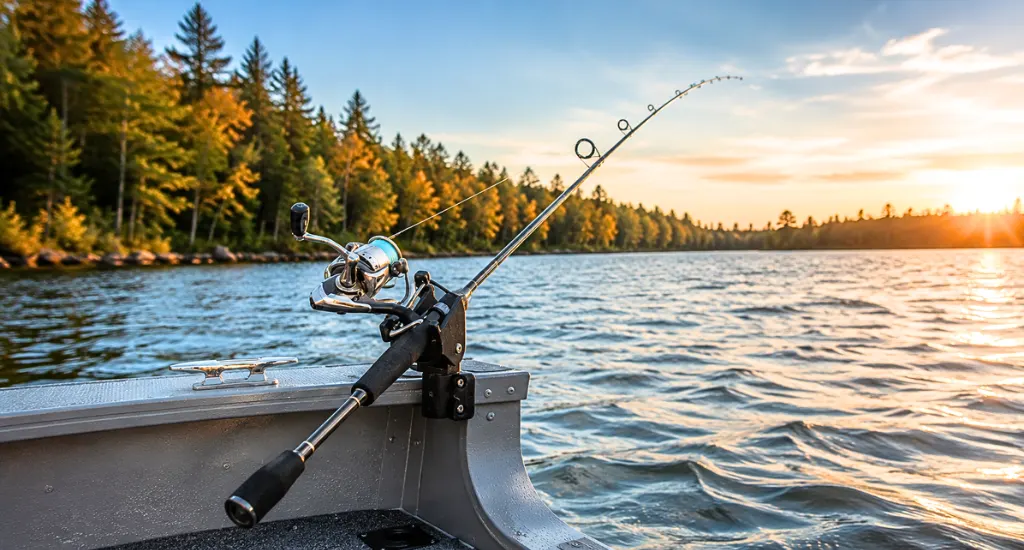
A salmon rod setup is a 9-weight, 9- to 10-foot rod with a fast or moderate-fast action for distance and control. Use an 8-weight for smaller Coho, Pink salmon, or small-river Atlantic salmon. Use a 10-weight for large Chinook and big water.
Best Fly Reels for Salmon Fishing
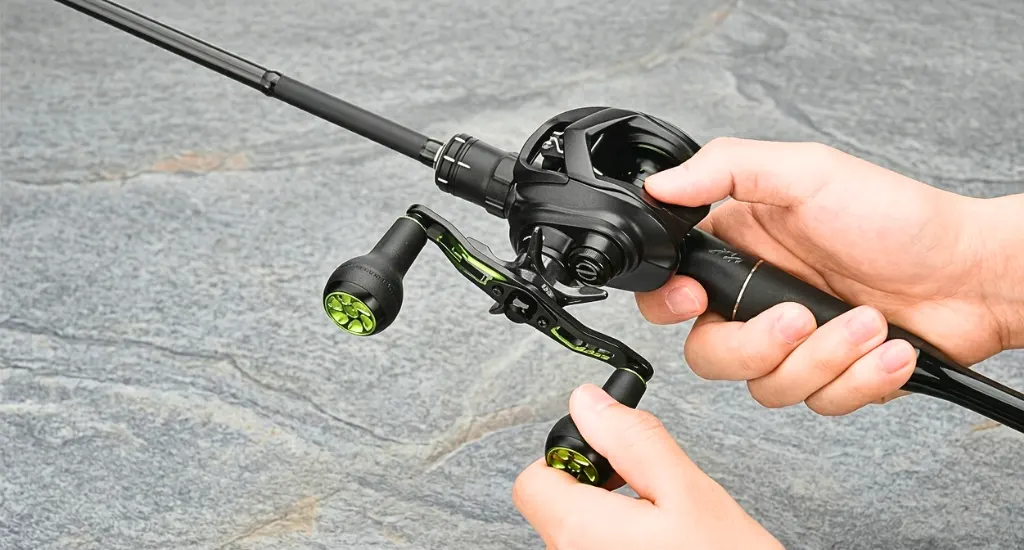
A salmon fly reel needs a smooth, sealed disc drag and enough backing for long runs. Choose a large arbor reel that retrieves line quickly when fish charge at you. Match capacity to species: 150 yards for smaller salmon, 200+ yards for Chinook.
How to Set Up Your Salmon Fly Line, Leaders, and Tippet
A salmon line system consists of backing, fly line, sink option, leader, and tippet. Start with 20 to 30 lb backing, then add a weight-forward floating line for single-hand rods, or a Spey floating line for two-hand rods. Control depth with sink tips or 5- to 10-ft polyleaders. Use Type 3 for moderate depth and Type 6 for deeper, faster water.
For leaders, use 9 to 12 ft on single-hand setups and 6 to 8 ft on Spey setups, since polyleaders function as part of the leader. Add 18 to 36 inches of tippet. Use 10 to 12 lb for Pink and smaller Coho, 12 to 16 lb for most salmon, and 15 to 20 lb for large Chinook.
What Are the Best Flies for Salmon Fishing?
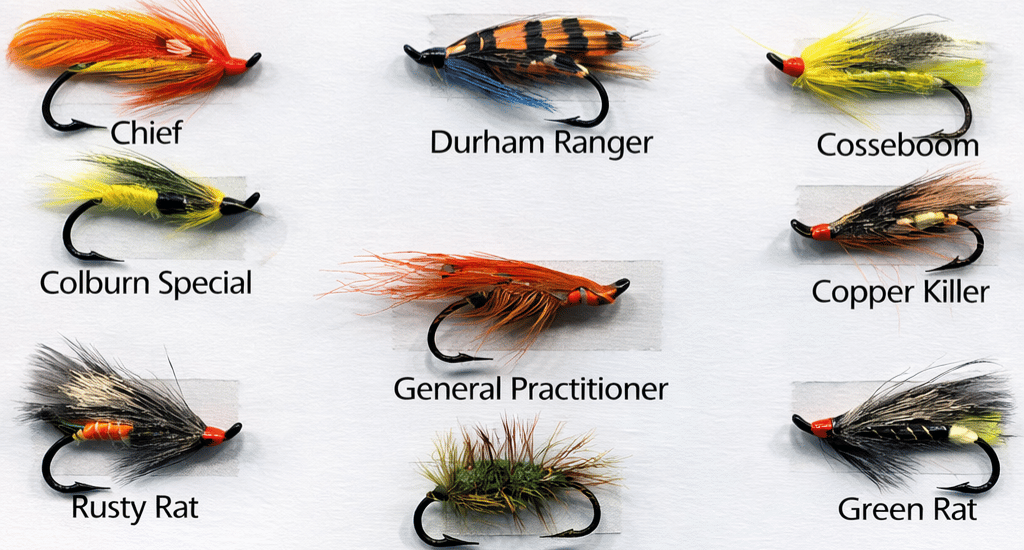
The best flies for salmon fishing are wet flies, intruder-style streamers, and egg patterns matched to water speed and depth. Presentation matters most, but fly selection improves results when salmon are selective or when conditions change.
Classic wet flies are the traditional choice for swinging. They are sparse, balanced patterns in sizes #2 to #8 that swim cleanly on a wet fly swing. Intruders and articulated streamers are larger, 3 to 6 inches, with more movement for Chinook and Coho in deeper pools. Egg patterns like Glo-Bugs and sucker spawn are dead-drifted through spawning areas and take fish across species. Flesh flies are a post-spawn tool when decaying salmon flesh becomes part of the river system. When pressure is high, and water is clear, downsize to small flies like the Snail Do in #8 to #12.
Pair the fly with the right sink tips for control. Large flies in fast water often need Type 6 tips to reach the strike zone. Small flies in slower water often fish best on a floating line or a lighter tip.
Comprehensive Salmon Fly Pattern Reference Table
| Fly Pattern | Type | Size | Colors | Best Use and Description |
|---|---|---|---|---|
| Ally’s Shrimp | Wet Fly | #2 to #6 | Black, orange, pink | Classic Atlantic salmon swing fly. Strong choice in clear to medium water. |
| Green Highlander | Wet Fly | #2 to #8 | Green, yellow, silver | Traditional pattern that swings well in moderate current across salmon species. |
| Intruder (various) | Articulated Streamer | #1 to #4 | Black, purple, pink, chartreuse | Big profile for Chinook and Coho. Fish with sink tips in deep pools. |
| Glo-Bug | Egg Pattern | #4 to #10 | Pink, orange, chartreuse, peach | Universal egg imitation. Dead drift through runs and spawning zones. |
| Woolly Bugger | Streamer | #2 to #8 | Black, olive, white, purple | Versatile leech or baitfish pattern. Swing or strip year-round. |
When is the Best Time to Fly Fish for Salmon?
The best time to fly fish for salmon is when runs enter freshwater and conditions drive fish to move. Salmon river timing is not like trout fishing. Salmon arrive in migration windows set by species, region, rainfall, and water temperature, so planning around run timing matters more than any single fly.
What is the Most Popular Time to Fish for Salmon (Mid- to Late September)?
Mid- to late September is the most popular time to fish for salmon on many rivers because peak seasons overlap. Fall Chinook runs often build from September into October, and September is the prime month for Coho in many Pacific Northwest, Alaska, and Great Lakes systems. Fresh fish tend to be more aggressive; rivers hold higher concentrations; and the weather is usually cooler than in late summer.
Regional timing still varies. Alaska commonly peaks from July to September, with August often the strongest. Washington, Oregon, and British Columbia often fish best from September to November, with mid-September into early October a common peak. Great Lakes runs often peak in late September. Atlantic salmon in Eastern Canada can be fished for from June through October, with September a frequent high point.
Daily and Tidal Timing for Salmon Success
Daily timing improves odds. Dawn and dusk are reliable windows because salmon move more confidently in low light. Overcast days can be good for all-day fishing. In coastal rivers, incoming tide often triggers movement in the lower river, especially two hours before high tide through high tide. Rising water after rain is a classic migration trigger, while very warm water can reduce activity and increase stress.
Where Can You Fly Fish for Salmon?
You can fly fish for salmon across the Northern Hemisphere in rivers fed by ocean runs and large lakes. The best salmon fishing locations share the same ingredients: cold water, migratory access, and enough flow to create holding water. Your choice is usually about species and access, not whether salmon live there.
Where to Fly Fish for Salmon in North America
1. Fly Fishing for Salmon in Alaska
Fly fishing for salmon in Alaska is the benchmark because all five Pacific species are available, and abundance is high. Bristol Bay rivers like the Kvichak, Nushagak, and Alagnak are famous for Sockeye, Chinook, and Coho. The Kenai Peninsula offers the Kenai River for large Chinook and the Russian River for Sockeye. Typical timing is Chinook June to July, Sockeye June to August, and Coho July to September. Access ranges from fly-out lodges to roadside fishing, but rules can be complex.
2. Pacific Northwest Salmon Fishing (Washington, Oregon, British Columbia)
The Pacific Northwest is the most accessible option for many anglers. Washington rivers include the Skagit and Skykomish, plus Puget Sound tributaries like the Snohomish, Stillaguamish, and Green. Oregon highlights include the Deschutes (lower sections), Sandy, and Rogue. British Columbia offers major Spey destinations, including the Skeena system, Fraser tributaries, and Vancouver Island rivers such as the Gold and Stamp.
3. Great Lakes Region Salmon Fishing
Great Lakes salmon runs offer strong fall fishing with low travel costs. Lake Michigan tributaries include the Pere Marquette, Muskegon, St. Joseph, and the Root River. Lake Ontario’s Salmon River in New York is the headline destination, often peaking in late September and October. Public access and aggressive fish are the main advantages.
4. Eastern Canada Atlantic Salmon Rivers
Eastern Canada holds the strongest Atlantic salmon options. The Miramichi, Restigouche, and Bonaventure are premier rivers, while Labrador rivers like the Minipi and Eagle offer remote fishing. Expect strict catch-and-release rules and paid access or guided water.
Where to Fly Fish for Salmon in Europe and Beyond
Atlantic salmon migration in the European Atlantic is defined by Norway, Scotland, Iceland, and Russia. Norwegian rivers such as the Alta, Gaula, and Namsen are known for large fish. Scotland’s Spey, Tweed, and Dee carry deep tradition and estate-style access. Iceland’s rivers, such as Laxa i Adaldal and East Ranga are clear and productive.
Russia’s Kola Peninsula, including the Ponoi, is remote and lodge-focused. Beyond Europe, Kamchatka offers Pacific salmon; New Zealand has introduced Chinook into rivers like the Rakaia and Rangitata; and Japan’s Hokkaido holds Masu salmon for a unique niche trip.
What Beginner-Friendly Techniques Work for All Salmon Species?
Beginner-friendly salmon fishing techniques are simpler than they look. Salmon fishing for beginners works best when you stop chasing variety and learn one dependable presentation, then add good river positioning. These simplified methods catch Chinook, Coho, Sockeye, Pink, Chum, and Atlantic salmon, Atlantic and Pacific alike, because they trigger the same reaction strikes.
Start with the Wet-Fly Swing: The Universal Salmon Technique
The wet-fly swing is the universal technique for all salmon species. It is beginner-friendly because the current animation of the fly and your job is line control, not constant manipulation. A swung fly crosses a salmon’s field of vision under tension, which can trigger territorial aggression or curiosity even when the fish is not feeding.
Use a floating line in shallow water and a sink tip when you need depth. Cast quartering downstream around 45 degrees, then mend once after the cast to slow the swing and keep the fly fishing. Let the fly swing through the strike zone with a tight line. Hold the hang down for five seconds, then step 2 to 3 feet downstream and repeat. Start with simple flies that swing well: Woolly Bugger sizes #4 to #6, or classic wet flies like the Comet or Black Bear. Bright streamers in pink or chartreuse help when visibility is low.
How to Catch Salmon in a River: Understanding Position and Posture
Position and posture decide how much good water you cover and how safely you do it. Wade knee-to-thigh deep when possible. Deep wading reduces stability and limits your casting angles. Approach from downstream or cross-stream to avoid pushing a wake into the holding water.
Cover the run methodically. Start at the head, cast, take 2 to 3 feet of steps, and cast again. Keep 30 to 50 feet off likely lies, especially when fish are in 4 to 6 feet of water. Shuffle your feet, face upstream or quartering upstream while moving, and use a wading staff in a strong current. If wind is a problem, set up so it hits your non-casting shoulder.
Is Fly Fishing Good for Salmon? (Beginner Effectiveness)
Fly fishing is good for salmon and often more effective in clear water, shallow runs, and pressured rivers. A swinging fly naturally tracks through current seams, where hardware often snags or moves too fast. Conventional gear can help in very deep holes, muddy water, or high flows, but a clean swing and good positioning will match or beat it in the right water.
What Books Should I Read to Learn Salmon Fly Fishing?
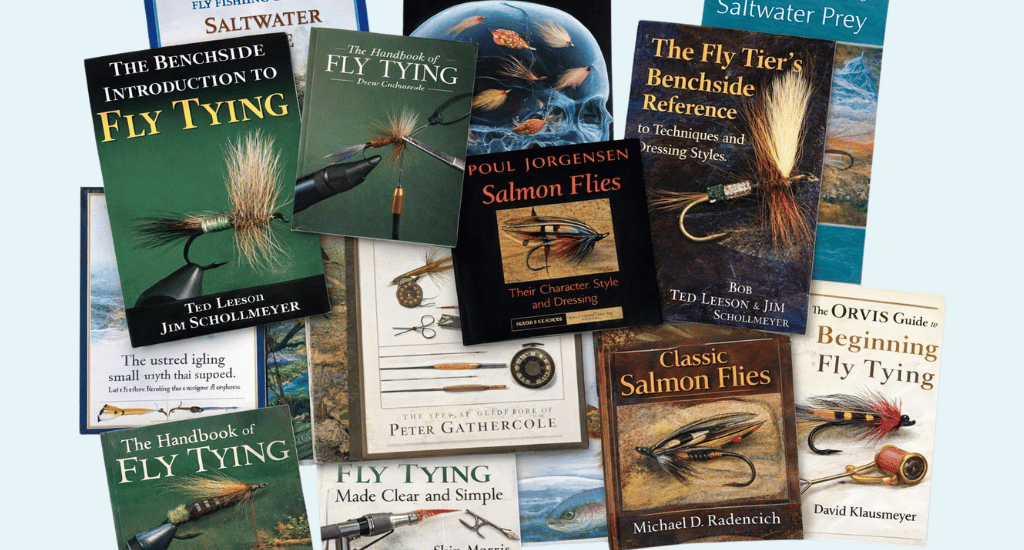
Reading a book on salmon fly fishing saves years of trial and error. Strong books explain why salmon react, how to control the swing, and how to adjust depth and speed without guessing. They also cover ethics, local rules, and river habits that keep fish healthy.
- Spey Casting (Simon Gawesworth): Step-by-step Spey fundamentals. D-loop, anchor placement, timing, and line control made clear.
- A Steelheader’s Way (Lani Waller): Swinging philosophy plus practical water reading, presentation discipline, and confidence-building repetition.
- Atlantic Salmon Magic (Topher Browne): Complete Atlantic salmon playbook. Flies, tactics, seasons, and river approach are explained with real context.
- Steelhead Fly Fishing (Trey Combs): Steelhead methods that transfer to salmon. Run selection, swing technique, and timing strategy.
- Fly Fishing Alaska (Anthony Route): Trip-planning guide. Alaska regions, access, seasons, and gear for Pacific salmon.
What are the Ethics and Conservation Practices for Salmon Fishing?
Ethical salmon fishing protects future runs. Catch-and-release is the standard in many fisheries, especially for Atlantic salmon and any river with declining returns. Use barbless hooks or pinch the barb, land fish quickly, and keep the fish in the water while unhooking.
Air exposure is the main mistake. Two minutes is not “fine.” A salmon should be out of the water for only a handful of seconds, just long enough for one or two quick photos.
Use a simple routine.
- Unhook the fish from the water whenever it is safe, ideally while it is still in the net. Get low, kneel if you can, and keep control. Salmon are powerful and slippery, and most injuries occur when anglers stand up to handle them over rocks or grass.
- If the fly is taken deep, do not dig for it. Cut the tippet close and release the fish. That choice usually gives the fish a better chance of survival than forced removal.
- If you take a photo, lift the fish only slightly above the surface and release it immediately. A solo photo with the fish resting in shallow water or in the net is more than enough, and often looks better.
- Handle the fish gently. Do not squeeze. Support the body with both hands, and keep fingers away from gills and eyes.
- To release, point the fish upstream and hold it lightly until it begins to kick with purpose. Then let it swim away from the spot it was caught.
Conclusion
Fly fishing for salmon gets easier when you simplify the puzzle. Find holding water, pick the right depth, and present with control. Start with the wet-fly swing, then add stripping in softer water and dead drifting when fish are pressured. Build your setup around a rod that matches your river, a reel with smooth drag and enough backing, and a line system that lets you quickly adjust sink rate.
Choose flies based on conditions, not trends, and time your trips around runs, low-light windows, and fresh water after rain. Finally, handle every salmon with care. How you release fish today shapes the fishing you get tomorrow.
FAQs
What is the Best Fly for Salmon?
There is no single best fly for salmon, but the Woolly Bugger in sizes #2 to #6 is the most versatile. Use intruders for Chinook, **Glo-Bug egg patterns in spawning areas, classic wets for Atlantic salmon, and Snail Do #8 to #12 for pressured fish.
Is Flossing for Salmon Legal?
Flossing, also called snagging or lining, is illegal in many places and considered unethical. Most rules require the fish to take the fly voluntarily and be hooked inside the mouth. Check your local regulations, because penalties can include fines and license loss.
How to Catch Salmon in a River for Beginners?
Start with the wet-fly swing in 4 to 10 feet of water with a walking-speed current. Use a 9-weight, floating line or sink-tip, 12 lb tippet, and a Woolly Bugger or egg pattern. Cast quartering downstream, mend once, step, repeat through seams, tailouts, and pool heads.
What is the Best Salmon Fly Fishing Setup?
A strong beginner setup is a 9-weight 9-foot rod, a large-arbor reel with smooth disc drag, and 150+ yards of backing. Fish a weight-forward floating line plus a Type 3 to Type 6 sink-tip, then add a 9-foot leader and 12 lb fluorocarbon tippet.
What Tackle Setup Do I Need for Salmon Fishing?
Use a 9 to 10 weight rod, a large-arbor reel with 150 to 250 yards of 20 to 30 lb backing, and a floating or sink-tip line. Add a 9 to 12-foot leader tapered to 12 to 16-lb tippet. Carry Woolly Buggers, egg patterns, intruders, and wet flies.
How to Fish for Salmon from Shore Without Wading?
Bank fishing works when you can reach deep runs, pools, or current seams. Use a longer 10 to 11-foot rod or a switch rod for reach. Swing at steeper downstream angles, or dead-drift egg patterns through visible lies. Dawn and dusk are the best windows.
Do I Need Different Techniques for Atlantic vs. Pacific Salmon?
The core techniques work for all salmon species, Atlantic and Pacific alike, but you adjust size and speed. Atlantic salmon often prefer smaller flies and subtler swings. Pacific salmon commonly respond to larger flies, faster swings, and stripping. The wet-fly swing still remains the baseline.