One angler’s journey into the mountain streams where the sport began-and the ancient fish still rising.
The fish came up slowly. Too slow.
Alberto Rey stood knee-deep in water so clear it seemed like standing in air, watching an Iwana rise from its lie on a gravelly sandbar. The char drifted upward through the current with deliberate calm—no rush, no hesitation—inspecting the orange-winged mayfly pattern overhead the way a monk might consider a cup of tea.
Then it ate.
Rey nearly forgot to set the hook.
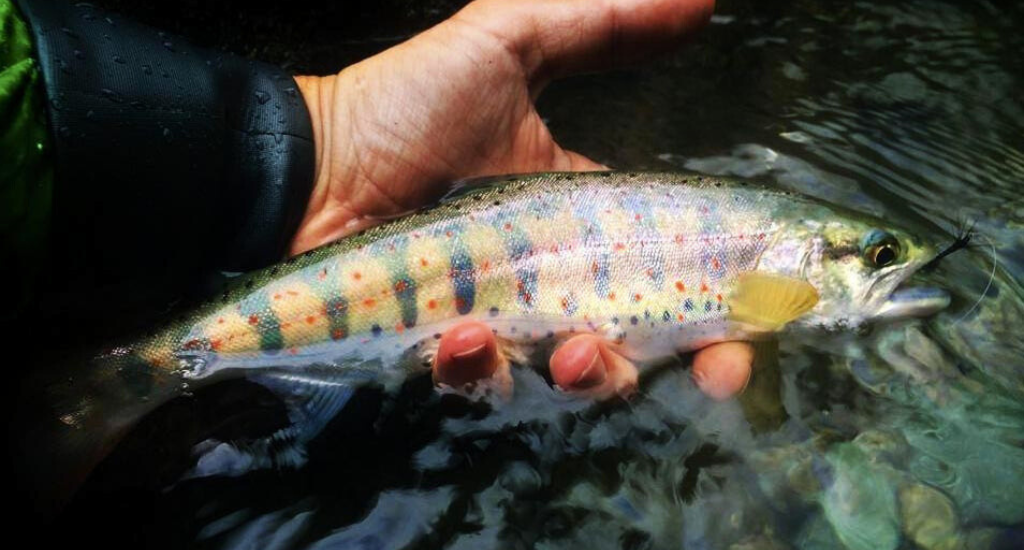
Three hours earlier, he’d been in Tokyo. Now he stood in a Japanese mountain stream with snow-capped Mt. Fuji framed in the distance, cradling a fish that existed in these waters long before fly fishing had a name in the West. The Iwana’s pale spots glowed against its slate-colored body—familiar enough to remind him of brook trout back home in New York, yet somehow older. Wilder.
This was the water where it all began.
The Destination Nobody Mentions
Most fly anglers can name their bucket list without thinking. Montana. New Zealand. Patagonia. The usual suspects, worn smooth by magazine covers and Instagram feeds.
But mention Japan, and you get a pause. A tilted head. Wait—you can fly fish in Japan?
You can. And when you do, you’ll find yourself in one of the few places on earth where the sport’s oldest traditions still flow through streams no wider than a country road. Where native trout are known as Iwana and Yamame. Where mountain fishermen have pursued these fish for over four hundred years using Tenkara—a method so simple it feels like a secret: a rod, a line, a fly. Nothing else.
No reels. No complicated gear. Just the essential act of presenting a fly to a fish, stripped to its purest form.
The problem is finding your way in. Almost no English-language information exists. Licensing operates stream by stream. Tenkara isn’t even considered fly fishing in Japan—it’s simply how mountain fishing has always been done.
Yet for anglers willing to navigate the barriers, something rare waits in those mountains. A chance to stand where fly fishing began and feel what it meant before it became an industry.
Finding a Way In
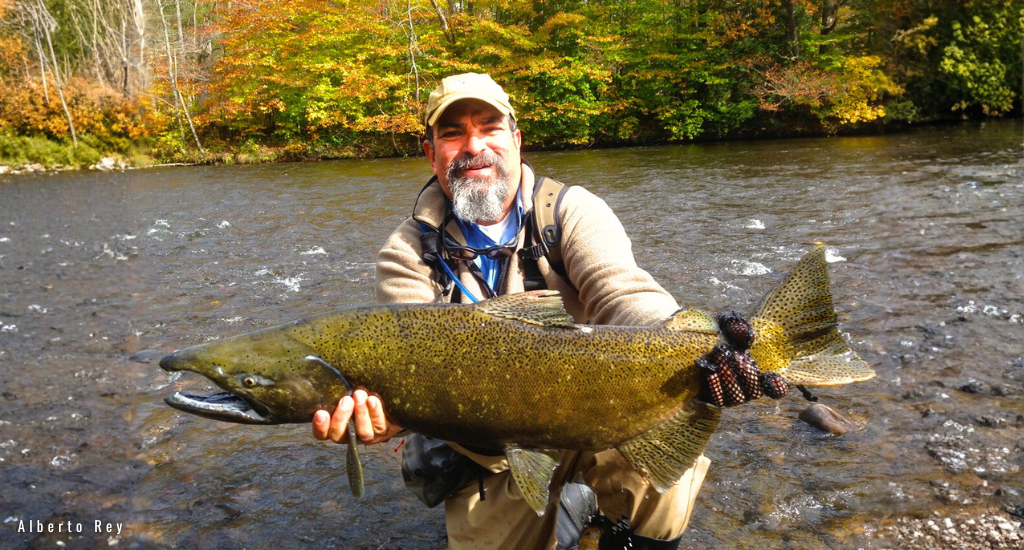
Alberto Rey doesn’t fish casually. A steelhead guide from western New York and Orvis’s 2021 Fly-Fishing Guide of the Year, he wasn’t about to skip Japan during his round-the-world trip with his wife. Getting on the water, however, proved complicated.
The path came through a chain of contacts-the way most things do in fly fishing. Rey reached out to Phil Monahan at Orvis. Monahan connected with Brad Befus at Scientific Anglers. Befus linked him to TIEMCO, the Japanese tackle company. Their representative was too busy to fish but knew someone who wasn’t.
His name was Motohiro Ebisudani. Everyone calls him Ebi.
Ebi picked Rey up at 6:30 a.m. in a narrow black van, and they escaped Tokyo’s crowded streets together. During the drive, they talked fish and home waters – the universal language of anglers. Then Ebi mentioned something that stopped Rey cold.
Taimen. In Japan.
Most anglers associate those giant salmonids with Mongolia or Russia. But Japan’s northern island of Hokkaido holds its own population of Sakhalin Taimen—fish exceeding a meter in length. Rey filed that away for another trip. Today, he was after something different.
The city gave way to forest, forest to mountain road. Then, through a gap in the trees: Mt. Fuji, snow-covered and impossibly perfect.
An hour later, they were standing in the water.
Where Tradition Meets the Rise
The stream could have been transplanted from Appalachia—freestone bottom, dense canopy, rhododendrons crowding the banks. But the geology whispered something older. Volcanic rock. Water carved by forces that predated human footprints on either continent.
Rey rigged a 15-foot leader, longer than most Western anglers would consider practical. Ebi insisted.
“The fish here see everything.”
He wasn’t exaggerating. The Iwana and Yamame inhabiting Japan’s mountain streams have survived four centuries of fishing pressure by developing preternatural awareness. A shadow. A flash of movement. The slightest drag on a fly. Any misstep sends them rocketing for cover.
Catching them demands a different approach. Shorter casts. Sidearm presentations under branches. Absolute stealth.
The first Iwana materialized from a pool no bigger than a bathtub. Rey watched his fly—an orange-winged mayfly tied by Ebi—drift along the seam between fast water and slow. The fish rose from the gravel like a ghost, gaining substance, hanging just below the surface with that maddening patience.
Then they eat. The hookset. The electric connection was traveling up the line into his hands.
He’d caught thousands of trout across dozens of countries. This one felt different.
Later came Yamame—the landlocked salmon Japanese anglers call cherry trout for the pink flush along their flanks. Both species wore parr marks that persist throughout their entire lives, unlike their American cousins.
“They reminded me of our brook trout,” Rey observed. “Beautiful little gems.”
But the comparison felt incomplete. These weren’t hatchery fish or naturalized populations clinging to marginal water. These were the originals—the fish that taught Japanese mountain fishermen to tie flies from feathers and silk four hundred years before Izaak Walton wet a line.
What the Water Teaches
Standing streamside, watching Ebi work a likely pocket with the efficiency of ten thousand previous casts, Rey understood something about Tenkara that no gear review had conveyed.
It wasn’t minimalism as a lifestyle brand. It was simply what worked. What had always worked. A direct line between angler and fish, nothing extraneous in between.
Western fly fishing evolved to solve problems these mountain fishermen never faced—distance, wind, open water. But here, in tight corridors of stone and vegetation, the old way still made perfect sense.
By the time they hiked out, Rey had landed enough fish to call it successful by any measure. More importantly, he’d found something rare: genuine discovery in a sport saturated with content and commerce.
“I feel as though I’ve met a new friend in Ebi,” he later wrote, “and I hope we will meet again on my home waters.”
For Those Ready to Follow
The path isn’t easy. The language barrier is real. Information stays scarce. Most Western anglers will never make this trip.
That’s part of what makes it worth taking.
The season runs from May through September. Nagano and Nikko offer accessible fishing from Tokyo, with English-speaking guides through services like TROUT & KING and Maki Caenis. Hokkaido holds wilder water and those Sakhalin Taimen waiting in the north.
None of it is simple. All of it is worth it.
Because somewhere in those mountains, in crystal-clear streams fished for four centuries, an Iwana is holding in the current. Rising with the same unhurried grace that taught Japanese anglers the value of patience long before the rest of us discovered fly fishing.
And if you’re quiet enough—careful enough—you might just watch it eat.