Some trips you remember because of the fish. Others you remember because of what they do to the angler. Alex Levy’s first offshore trip was the second kind.
Alex had spent years working inshore water – redfish, trout, the familiar rhythms of coastal bays and grass flats. Good fishing, but bound fishing. When he stepped onto the boat at 4 AM for his first run offshore, he was walking into something with no ceiling on it. Seventy miles of open ocean, Mahi on weed lines, red snapper on the reef, and a full day ahead of him that would not end until well after dark.
What happens to an angler the first time the water gets that deep and the fish get that powerful is worth paying attention to.
Alex Showed Up Before Anyone Asked Him To
The boat lights were already on when Alex pulled up to the dock. Most first-timers hang back and wait to be told what to do. Alex grabbed gear and started loading.
He helped rig bait, organized fishing poles, and made sure everything was aboard before anyone had to ask him twice. That kind of attitude matters on a boat. It tells the crew what kind of day they are in for before the lines ever hit the water. Alex came to fish, not to watch.
By the time everything was squared away, coffee and Red Bulls were making the rounds, and the boat was ready to move. They pushed off the dock into the dark, music low in the background, and settled into the 1.5-hour run to the fishing grounds nearly 70 miles out.
The inshore world Alex knew was already behind him.
Seventy Miles Out – When the Water Changes Everything
Halfway through the run, someone called for a stop.
The sun was just breaking the horizon, and there was nothing around them but open ocean in every direction. No shoreline, no reference point, nothing to anchor the eye. For someone who had spent their fishing life within sight of land, that view lands differently. Alex went quiet. Most people do.
When they reached the fishing grounds, the mood on the boat shifted. The music went down, eyes went to the water, and the search for weed lines began. Offshore Mahi do not sit in one place and wait – you hunt for them, reading the surface for floating debris, color changes, and the ragged lines of sargassum weed that hold bait and, below it, fish.
Then the crew handed Alex the helm and told him to steer while they watched the lines. He did not hesitate.
How We Found the Mahi – Reading the Water Offshore
Weed Lines, Floating Debris, and Temperature Breaks
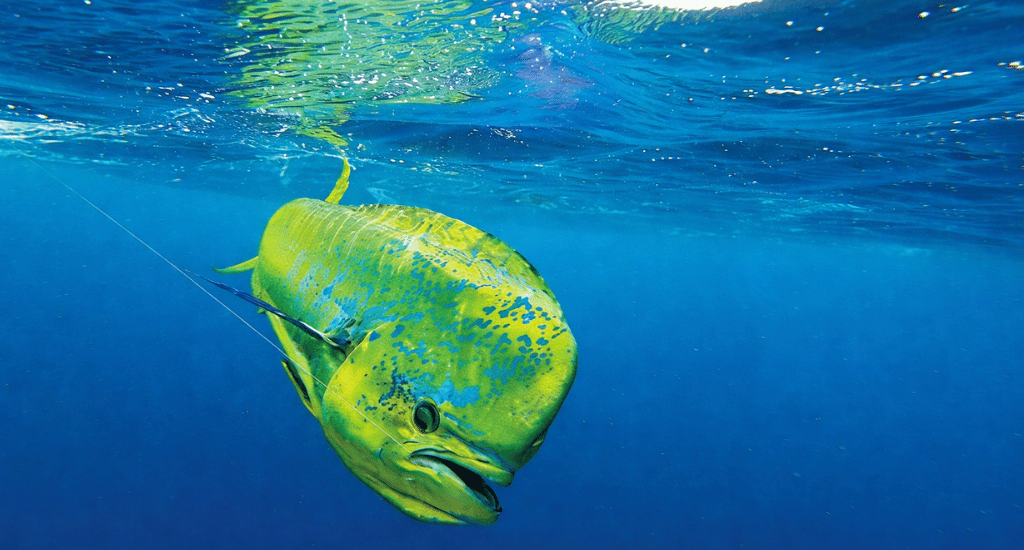
Caleb pointed off the starboard side and told me to stop staring at the horizon and start reading what was right in front of us. “If you want to locate Mahi offshore to feel less like luck,” he said, “look for places that trap food.” The first sign was a clean weed line, not scattered sargassum, but a defined edge. “Mahi weed lines matter because baitfish use them like cover,” he explained. “They hide, they feed, and the Mahi Mahi cruise the seam.”
A few minutes later, we spotted floating debris, a small patch of junk riding the swell. Caleb eased us up and kept his eyes on the shadow under it. “Anything floating can hold fish,” he said. “Debris makes shade. Shade holds bait. Mahi sits underneath and waits.” Then he showed me the screen and the watercolor shift. “See that slight change?” he asked. “That’s a temperature break. Offshore fishing temperature breaks are where warm and cool water meet, and bait stacks along the edge.”
What Tackle and Lures Work on Mahi
When we hit the weed line, Caleb already had the offshore fishing tackle setup ready. Medium-heavy rods, smooth drags, and leaders that could handle a fast run without getting bulky. “You do not need fancy,” he said, “you need reliable.” He clipped on simple lures that run clean at speed and look like an easy meal near the edge: small skirted baits and bright profiles that show up in blue water. “Mahi lures offshore should be easy for them to find and hard for them to ignore,” he told me, watching the spread settle in. “Keep it clean, keep it consistent, and be ready. When they show, they show fast.”
The Lines Went, and Alex Was Ready.
What It Feels Like to Reel In Your First Mahi
The strike was not subtle. One second, the lure was skating clean, the next the rod buckled, and the reel started talking. Alex Levy froze for half a beat, eyes wide, and Caleb was already on him. “Do not yank,” he said. “Let the rod load, keep the tip up, and start gaining line.” Alex leaned back, felt the weight, and the fish answered with a hard run that peeled line fast.
“Now you follow it,” Caleb told him, hand on the gunwale, watching the angle. “Keep line tension. If it runs, you let it run. When it pauses, you take it back.” Alex started to find the rhythm, rod up to lift, reel down to gain, breathing like he was trying not to think. The Mahi Mahi threw a quick shake on the surface, and Caleb nodded. “That is the fight. Steady pressure, no slack. You fight them by staying connected.” Alex did, and inch by inch the run shortened.
When the Fish Came Alongside the Boat
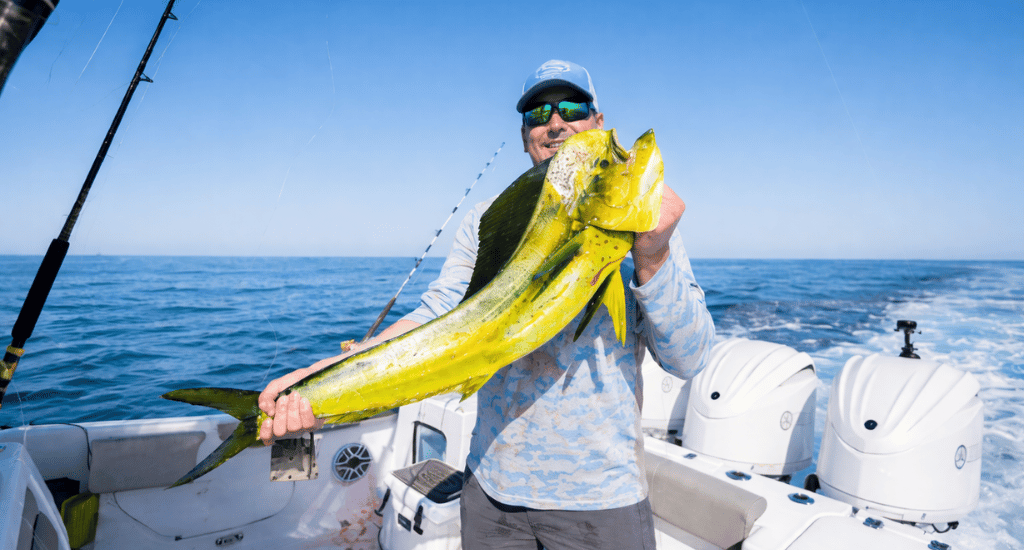
The first flash of color looked unreal, like someone dropped a piece of neon into the water. Green and blue, then gold, then a bright flare as it rolled near the boat. Alex leaned over and laughed, half disbelief and half relief, still gripping the rod as it might jump out of his hands.
Caleb guided the last few feet with the same calm voice he used all morning. “Easy now. Head up. Keep it coming.” When the fish came tight to the hull, it kicked and sprayed, and Alex took a streak of Mahi blood across his forearm like it was a uniform. Caleb glanced at him and smiled. “First one always marks you,” he said. “That is how offshore fishing gets its hooks in.”
The Reef Stop – Switching Gears for Red Snapper
How Structure Fishing for Snapper Works
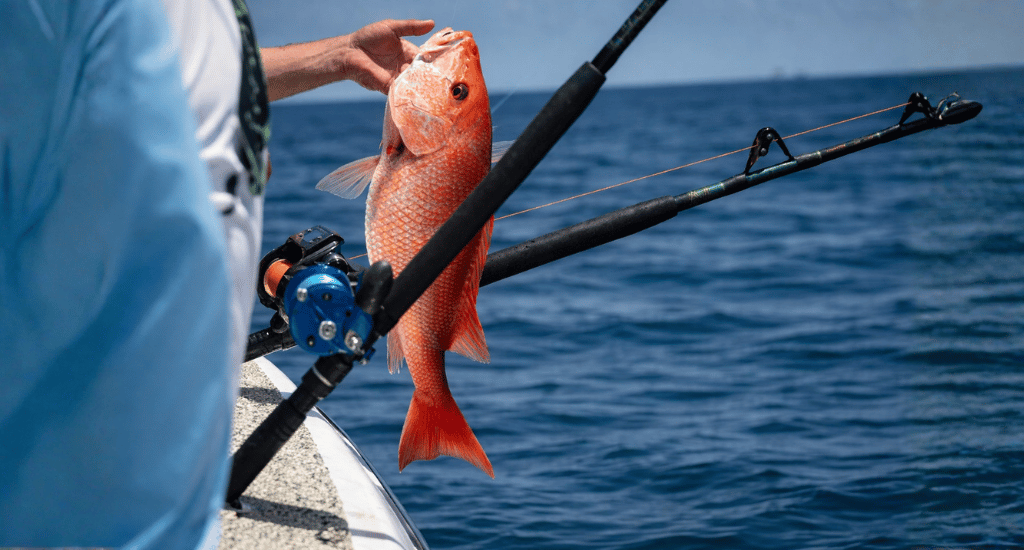
On the way back, with the sun sliding lower and the Mahi bite behind us, Caleb turned the bow toward a reef he knew like an old address. “We stop here because snapper live on structure,” he told Alex, tapping the chart. “It is home, it is cover, and it is where the groceries show up.” Red snapper reef fishing was nothing like the surface game we had played all day. No chasing weed lines, no watching for a strike in open water. This was a deep drop snapper technique, straight down into a place you cannot see.
Alex looked over the side like he was trying to stare through the Gulf Coast. Caleb handed him the setup and kept it simple. “We target the up-current edge and the hard bottom,” he said. “Drop until you feel it, then come up a crank so you are not buried.” For bait, he went with the obvious, something that smells like food and stays on the hook. The rigging was built to reach depth and hold steady, not flutter on the surface.
The Snapper That Capped the Day
The bite on snapper is different. Alex felt it as a heavy thump, then a steady pull that did not run fast; it just dug down and stayed there. He leaned back and started grinding, face tight, rod bowed deep. Caleb watched and nodded. “Mahi fight bright and wild,” he said, “but a snapper just tries to live in the reef.”
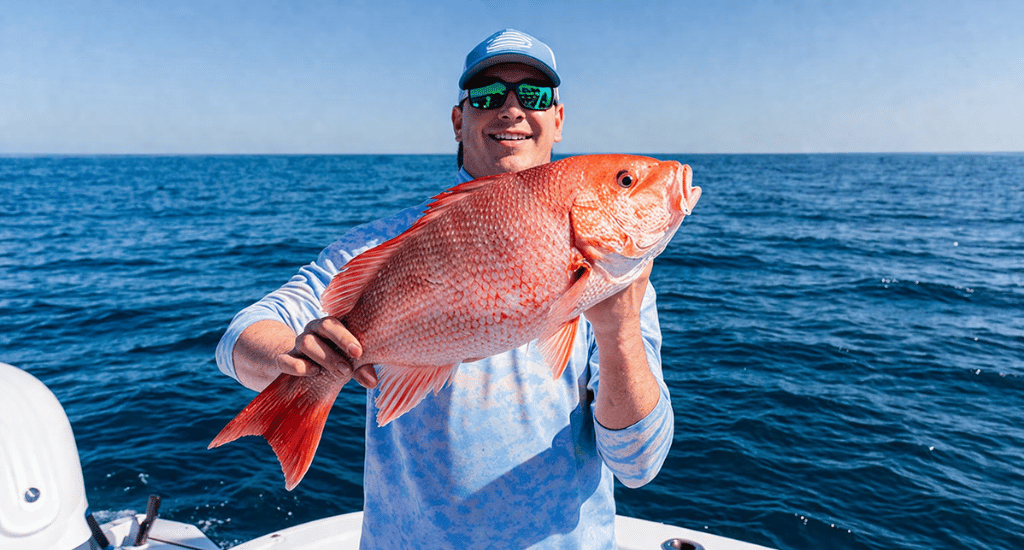
When the red snapper finally broke the surface, it looked like a dinner plate with fins, solid and unmistakable. “That fish matters here,” Caleb said, “because on the Gulf Coast, snapper is the payoff stop when the surface bite goes quiet.” Alex held it up, tired and grinning, and then we pointed for the dock. Sixteen hours on the water makes everybody honest. We cleaned the boat in silence, salt-stiff and satisfied.
When and Where to Chase Mahi and Snapper Offshore
Caleb’s quick rule set from running these trips on the Gulf Coast:
- Season
- Mahi Mahi: Late spring through early fall is the sweet spot offshore. When surface temps stay above 70°F, the odds jump, and the weed lines get alive.
- Red snapper: The red snapper season on the Gulf Coast is tightly regulated. Always check the current Gulf of Mexico federal season dates before you plan a trip or book a run.
- Location
- Mahi: Look for a weed line or floating debris in warm months. On many days, that means running 50 to 100 miles offshore, then hunting edges where bait stacks.
- Snapper: Think reef structure and hard bottom. Depth changes by area and target size, but the idea stays the same: structure holds fish.
- Strategy
- Run to weed lines first while energy is high. When to fish Mahi offshore is when you can stay active and visual.
- Save the reef stop for the ride home. It extends the day without adding miles.
- Watch birds working the surface. They usually mark bait, and Mahi feed below it.
A Few Days Later – Alex Made Mahi Tacos
A few days after the trip, Caleb got a photo from Alex Levy that said everything. Alex was in his kitchen, sleeves rolled up, a cutting board full of clean white Mahi Mahi, and a pan heating like he had done it a hundred times. He told Caleb the whole day replayed while he cooked it, the weed line, the first strike, the color at the boat, and the reef stop on the way home. Then he sent the final shot: Mahi fish tacos stacked high, simple and perfect.
Caleb laughed when he saw it. “Catch and cook offshore tastes different,” he said. “Not because of the recipe. Because you remember every mile it took to earn that bite.”
What Alex Got Right – And What Any First-Timer Should Know
Caleb has seen plenty of first-timers. Alex did a few things right without being told, and it changed the whole day.
- Show up early and pitch in without being asked
- Learn what a weed line is before you leave the dock
- Let experienced anglers guide the fight the first time
- Dress for the ride out – 70 miles offshore at 4 AM is cold
- Bring more food and water than you think you need
- Never skip the reef stop – the best moment sometimes comes last
Conclusion – What Offshore Fishing Does to an Angler That Inshore Never Quite Manages
Caleb has guided enough trips to recognize the shift. Offshore fishing resets your frame of reference. The distance, the depth, the long quiet between bites, then the sudden violence of a strike – it makes inshore feel smaller without making it lesser. Alex Levy came back a different angler. Not louder, not braver, just more patient and more aware of what the water can hide and reveal.
Caleb says that is the real souvenir: the offshore fishing experience follows you home and changes how you fish everywhere else.